|
|
|||
![]() |
Department of Engineering |
| University of Cambridge > Engineering Department > News & Features |
15 November 2004
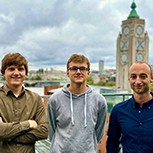
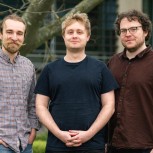
Nic Lawrence, Edward Buckley, Adrian Cable and Peter Mash, researchers within the Photonics and Sensors Group at the University of Cambridge, Department of Engineering are developing ground-breaking holographic technology, which will power a new generation of pocket-sized digital video projectors.
Digital video projectors that produce large, high quality images are becoming increasingly popular, but there are limitations in the technology that make miniaturisation very difficult, preventing projectors from making inroads into the potentially lucrative mobile device markets. Why has this not been done before?The concept of a holographic projector is not new, but up until now technical issues have prevented development of an actual product based on this technology.
In the Photonics and Sensors Group in the Department of Engineering, , liquid crystal over silicon (LCOS) devices have been developed for real-time
holographic displays as well as applications in telecoms systems. Several major breakthroughs have been made,
together making possible the generation and display of high quality holograms at video frame rates, using
just a single custom chip that Nic Lawrence and his team have designed. How does it work?
A hologram pattern, which to the naked eye looks like a collection of random dots, is displayed on a small liquid-crystal-on-silicon (LCOS) microdisplay - a tiny, very fast liquid crystal display built on top of a chip. The hologram patterns are calculated by Light Blue Optics' proprietary "hologram chip" so that when the microdisplay is illuminated by laser light, the light interferes with itself in a complex manner through the physical process of diffraction which, when carefully controlled, results in the formation of a large, high quality projected image on, for example, a screen or a wall. Unlike a conventional video projector, heavy, bulky lenses are not required: diffraction does all the work for you, and the projected image is sharp and in focus at any distance. What will this lead to?There are a huge number of applications for this technology in fields including business, home entertainment, automotive, aerospace and advertising. At present, the focus is on 2D applications, in particular tiny personal projectors for business and home use. The illustration shows an artist's impression of a potential early product - a personal video projector, which you could download movies to and then play anywhere, using a wall as the screen. In the future, the same technology could be extended into 3D applications - while this is some way away yet, the technology could bring the holographic video displays of science fiction one step closer to reality.
When will products be in the shops?
At present, Light Blue Optics has a lab-based demonstrator, which converts a standard composite video signal
into high-quality 2D holographic video, in real time. The hologram generation engine runs in a commercially
available FPGA (field-programmable gate array) chip, whose design extends naturally to cheap mass production.
Other processing platforms including low-power digital signal processing (DSP) ICs are also under
development.
Email: nic@lightblueoptics.com For more information on research in the Photonics and Sensors Group in the field of holography, please contact Professor Bill Crossland or Dr Tim Wilkinson. Email: wac@eng.cam.ac.uk or tdw@eng.cam.ac.uk |
| | Search | CUED | Cambridge University | |
|
© Department of Engineering at the University of Cambridge Information provided by web-editor |