|
|
|||
![]() |
Department of Engineering |
| University of Cambridge > Engineering Department > News & Features |
4 March 2009

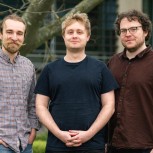
From left to right: Nathan Eng, Ana Medeiros,
Malia Kilpinen, Andrew Muir Wood, Anna Mieczakowski.
Five research students and Lecturer Nathan Crilly from the Department's Engineering Design Centre (EDC) took part in the 48-Hour Inclusive Design Challenge in Tokyo. The Challenge was collaboratively organised by the Royal College of Art Helen Hamlyn Centre, Nikkei Design and Tokyo University. The teams worked to a brief on the theme of disaster. "Design a product, service or system (communication or otherwise) that will be of fundamental assistance to a range of people, including older and disabled people, in the event of a natural disaster (earthquake, floods, typhoon or fire) within a high- density urban environment." The aim was to develop innovative mainstream products, services or environments.
Challenge participants were divided into three design teams (A-C) consisting of, among others, in-house designers from leading Japanese companies, engineering graduates from the University of Cambridge and the University of Tokyo. Each team, led by an experienced UK designer, worked with a disabled design partner and had input from disaster professionals.
Team A, including Ana Medeiros and Nathan Eng, developed the ‘Elixir’ bag, which can be used for both hydration and sanitation during the times of disaster. This product won two awards, one for ‘Best Design’ and the other one for ‘Most Innovative Product’, making Team A the main winner of the Challenge.
Team B, including Malia Kilpinen and Andrew Muir Wood, developed the ‘Crowdscape™’, which is an LCD-based navigation system that can be mounted on floors and walls of such public areas as train, bus and underground stations, as well as airports. Team C won the ‘Best Technology’ award.
Team C, including Anna Mieczakowski, proposed the ‘Know Your Way’ campaign, which stressed the importance of preparing and establishing a mental image of where the exits in a building are and how to get to them before a disaster strikes. Team C won the ‘Best Theme’ award.
Design Partner: Naoko Kojima - access consultant and designer
Natural disasters, like earthquakes and floods, critically damage systems in major urban areas. The first 72 hours are a critical challenge since only local and fast-response measures can be relied upon. Maintaining hydration (at least 3 litres per person per day) is always critical. Sanitation needs are also key. For example; within two hours of an earthquake in Tokyo, over eight hundred thousand people will need a toilet. During disasters, poor human waste management quickly contaminates exposed or damaged fresh water supplies. This leads to the spread of many water-borne illnesses, worsening the disaster. A good solution must address this range of issues.
The team developed an innovative solution based on a simple variation of a water bottle. The Elixir ergonomic liquid-delivery and sanitation system consists of a simple easy-pull wide-mouth cap, a standard aluminised polyethylene drink bag (250-500ml) and a waterproofed cardboard frame. It fulfils these critical disaster relief functions:
Although inspired by a disaster scenario, Elixir could be used in everyday situations which would ensure its commercial viability.
Thus Elixir is an inclusive, commercially viable product that aids urban disaster relief and general well-being.
Design Partner: Hiroshi Nimiya - profoundly deaf designer at Fuji Xerox
The team were assisted by Hiroshi Nimiya in understanding the problems he faces in using busy public spaces, and what his greatest fears would be should a disaster occur in these settings. These insights helped the team to identify an opportunity to assist general users of public spaces in the safe movement within and the exit from locations such as stations and shopping centres. Knowing when to go outside and when to remain within a building is crucial depending on the disaster context - in an earthquake remaining inside can be safer than going outside while conversely in a fire the opposite is true. Through expert consultation, technology and materials research and working alongside Hiroshi, the team developed Crowdscape.
Crowdscape is an intelligent crowd management system for public buildings that provides instruction and reassurance to high volumes of people using directional symbols. In a disaster situation, the safest course of action is not necessarily to leave - therefore the system simply instructs the best solution for the given context - to move in a given direction or to stay put. The system consists of modules that can be mounted on the floor, wall, stairs or ceiling and that communicate wirelessly with a central control system. Based on feedback from existing infrastructure in the building, the modules are instructed to display simple LED symbols to inform the safe and efficient movement of people away from danger and obstructions. In case of a power cut, the modules contain their own long-lasting back-up power supply, which will allow continuous operation for days. Individual modules can be combined with each other to form larger shapes for a bigger visual impact. This system is useful not only in extreme disaster situations, but also for everyday problems such as during the rush hour or construction in a busy public space.
Design Partner: Masumi Suzuki - partially sighted university administrator
Disasters are not selective; they strike people of different ages, capabilities and beliefs. They often come undetected, giving people only a split second to escape. Every year, governmental institutions update disaster-related legislation and organise training programmes in order to teach people how to behave in the event of a disaster. People are taught to be prepared, but they rarely imagine that their survival skills will be put to the test. Consequently, when a disaster happens, people are often so shocked and panicky that their reaction and movement times are substantially slowed down.
There are different strategies for surviving disasters, among which a quick escape is of the highest importance. For that reason, the government provides legislation to ensure that every building has well-verified and signposted fire escapes. When the evacuation infrastructure is in place, it is then people's responsibility to become familiar with the exit strategy.
Drawing on the experience of a blind person who needs to have a prior detailed plan and a mental image of every movement she makes; the team found that knowing the precise position of a building's exit points, and as importantly how to get to them, can save lives when a person is caught up in an unknown environment, dust, smoke or in darkness.
The team believe that the best way to raise awareness about survival strategies is through a clear and well-implemented campaign. The UK-based 'Clean Your Hands' campaign and the Japanese 'OKASHIMO' campaign are examples of successful campaigns that increased human awareness and saved many lives. Therefore, the team proposed the 'Know Your Way' campaign, which stresses the importance of preparing and establishing a mental image of where the exits in a building are and how to get to them before a disaster strikes. The logo of the campaign is represented in Japanese kanji characters and in direct translation it means that 'knowledge leads your way out'. The team used international signage iconography as the basis of the design, with the additional depth of meaning in the character itself. Moreover, the fact that the character looks like a person allows the logo to work across languages. Since one of the crucial actions to take during the times of a disaster is to remain calm, our logo has been represented in blue, which signifies calmness in Japanese. In addition, the simple design of our logo works in low resolution formats such as newsprint or television, as well as in high resolution formats.
The 'Know Your Way' campaign is inclusive as it applies to people of different ages and capabilities, and different disaster scenarios. If well received, the 'Know Your Way' campaign could be implemented in various educational formats, such as cartoons, announcements, computer games, board games and soap operas. Also, once the campaign is well recognised, its logo can be installed in buildings, on aircrafts, the underground, and in communal areas.
Know your way and save your life!
The results of the competition were presented to Design Innovation Forum delegates from industry and academia. More details about the event can be found on the Helen Hamlyn website
| | Search | CUED | Cambridge University | |
|
© Department of Engineering at the University of Cambridge Information provided by web-editor |