
Traumatic Brain Injury (TBI) needs to be urgently prioritised on the world health agenda, argue researchers from the Departments of Engineering and Clinical Neurosciences who are working together as part of the Global Coalition for Traumatic Brain Injury.
TBI is one of the great overlooked crises of our time, and remains a silent epidemic. 69 million injuries every year, yet barely visible in global health policy or financing. The 79th World Health Assembly in Geneva felt like a turning point. To see a formal draft resolution submitted to the WHA, backed by ministers from across four continents, was a remarkable thing to witness.
Dr Brandon G. Smith
Annually, an estimated 69 million people worldwide sustain a TBI, making it the leading cause of death and disability in people younger than 40 years – it exceeds the combined global burden of HIV, tuberculosis, and malaria combined.
TBI can impact anyone at any age, with the potential for lifelong disability and chronic health issues. 89% of TBI cases worldwide occur in low and middle-income countries, where there are more injuries, and patients often lack access to timely, safe and high-quality care, resulting in poorer health outcomes. The incidence is rising sharply, driven by rising rates of road traffic injuries, violence, conflict-related trauma, and hazards at work. In these settings, capturing the full extent of brain injury across populations is also challenging, making prevention strategies difficult to implement.
TBIs, even mild ones, can trigger lifelong cognitive, emotional, and neurological issues. This can lead to permanent disability, leading to financial strain on individuals, families, and national health systems. In these cases, carers are often unpaid family members. Between 2015 and 2030, TBI is projected to cost low-and middle-income countries more than US$1·1 trillion in lost productivity, lost wages, disability, and premature death.
But despite being such a major global health issue, TBI has remained largely absent from international health policy and financing. The World Health Organization (WHO) and most of its member states have yet to formally classify TBI as a chronic condition or to include it in surveillance systems.
The Global Coalition for Traumatic Brain Injury, representing hundreds of organisations spanning clinical leaders, researchers, policy makers, people with lived experience, and member states, has coalesced behind a unified call for change. They are campaigning for TBI to be formally adopted as a notifiable and chronic condition in a proposed resolution of the World Health Assembly (WHA) in 2027.
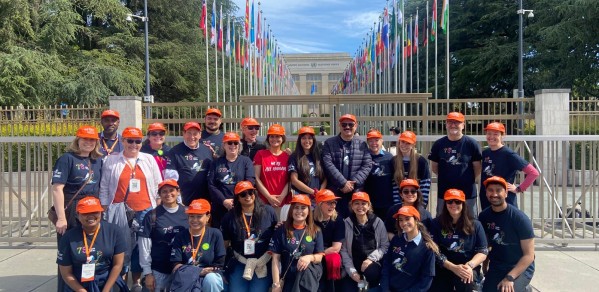
The Coalition recently hosted an event at the 79th WHA in Geneva, setting down the path to make their case by next year. The event helped to build political momentum behind a formal WHO resolution. Pakistan submitted a draft resolution to the 79th World Health Assembly calling for TBI to be recognised as a notifiable and chronic condition, meaning it would be formally tracked, reported and resourced within national and global health systems in the same way as other major non-communicable diseases. With co-sponsors and ministers from Europe, the Americas, Africa and across Asia behind it, the goal is to resolve a reality at the 80th World Health Assembly in 2027.
Tom Bashford, Tamara Banerjee, Laura Hobbs, and Brandon G. Smith, from the Department of Engineering at the University of Cambridge, are members of the coalition. They teamed up with Professor Peter Hutchinson and Ms Sara Venturini from the Department of Clinical Neurosciences as part of the Cambridge team representing the Global Coalition for Traumatic Brain Injury. They are building on last year's efforts at the 78th WHA, and planning to propose a resolution at the 80th WHA.
Brandon commented, "Our collaboration with Professor Peter Hutchinson and Ms Sara Venturini from Clinical Neurosciences, and with Dr Tariq Khan and Dr Almas Khattak from Peshawar, Pakistan, reflects the cross-disciplinary, cross-institutional partnership that complex global health challenges demand."
He added, "There is much more work to do, but fundamentally this is being realised through a coordinated, sustained multidisciplinary effort and we’re glad to be representing the Department on the engineering front and the role that health systems engineering and design will play in this."
TBI is fundamentally a systems problem. The injury itself may be acute, but its consequences ripple across health, education, employment, housing and social welfare, and for many, for a lifetime. TBI doesn't just change one life; it reshapes the lives of families, carers and entire communities. Engineering has a critical role to play in designing the systems that can actually respond to that complexity.
The engineers' contribution sits within health systems design, looking at how trauma care pathways, surveillance infrastructure, rehabilitation services and cross-sectoral coordination can be structured to meet the needs of TBI patients across the full care continuum, from pre-hospital response through to long-term community support. This systems thinking is especially important in resource-constrained settings, where the burden is often greatest.
Together with colleagues in the Department of Clinical Neurosciences, the engineers form part of the NIHR Global Health Research Group on Acquired Brain and Spine Injury, which has played a leading role in the 78th and 79th World Health Assembly side events as part of the wider Global Coalition for Traumatic Brain Injury; itself comprising over 130 organisations and 9 member states. The Department of Engineering team brings an engineering lens to a challenge that has historically been framed in purely clinical terms.
Brandon said, "TBI is one of the great overlooked crises of our time, and remains a silent epidemic. 69 million injuries every year, yet barely visible in global health policy or financing. The 79th World Health Assembly in Geneva felt like a turning point. To see a formal draft resolution submitted to the WHA, backed by ministers from across four continents, was a remarkable thing to witness."
Tom reflected, "What strikes me most is that this is fundamentally an engineering problem as much as a clinical one. How do we come together to build surveillance systems that actually capture the scale of this? How do we design care pathways that follow a patient from the roadside to long-term community support? How do we coordinate across health, education, employment and housing to meet needs that don't respect institutional boundaries?
"These are systems questions, and they will demand systems answers. That is what the International Health Systems Group at the Department of Engineering is working to contribute, alongside an extraordinary coalition of clinicians, researchers, policymakers and people with lived experience of TBI, spanning over 130 organisations and 9 member states. We leave Geneva with real momentum and motivation for the 80th World Health Assembly. The work continues.”
Coalition member Sara Venturini commented, “To address TBI globally, it takes a multi-faceted approach. We need to engage multiple professional groups and decision-makers. We are proposing a framework to include better surveillance, so we can create locally targeted prevention strategies, but also for improvements to acute care and rehabilitation infrastructure.”
“Our efforts through the Global Coalition for TBI make this goal possible. In 2022, the WHO created a global action plan for epilepsy and other neurological disorders, focusing attention on neurological conditions. With this as a base, there is a clearer path for us to advocate for TBI to be recognised as a global public health priority.”
Read the Coalition's recently published viewpoint in Lancet Global Health, which summarises the team's progress.
