

From non-invasive glucose monitoring to rapid food and materials analysis, a new class of optical spectrometer could transform how and where high-precision measurements are made.
The architecture is simple, scalable, and manufacturable, yet it delivers precision that rivals or exceeds much larger instruments.
Professor Richard Penty
Researchers from the University of Cambridge and GlitterinTech (a start-up founded by the same research group) have unveiled a fundamentally new type of optical spectrometer that delivers laboratory-grade precision in a device small enough to be embedded in portable and wearable technologies. By rethinking how spectra are measured and processed, the team has demonstrated a spectrometer costing around only $10, operating at centimetre scale, and capable of applications ranging from industrial quality control to real-time healthcare monitoring.
Optical spectrometers underpin countless technologies, from chemical analysis and manufacturing to environmental sensing and medicine. Yet shrinking these instruments has historically involved painful trade-offs: miniaturised devices typically sacrifice bandwidth, resolution, or accuracy, limiting them to rough identification rather than true metrological measurements. The newly reported convolutional spectrometer overcomes these barriers by introducing a conceptually elegant operating principle grounded in the convolution theorem, offering unprecedented performance metrics compared with existing dispersive, Fourier-transform, and reconstructive spectrometers.
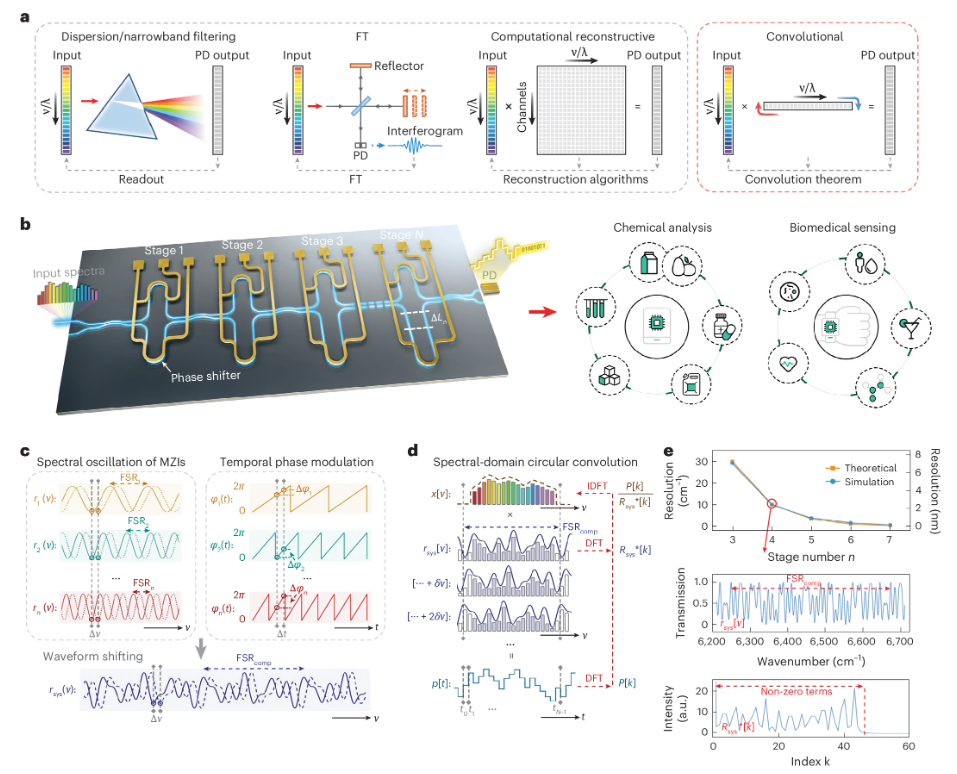 Image above: Defining a new class of spectrometer based on the convolution theorem (diagram from Nature Photonics). a, Comparison of spectrometer types and the proposed convolutional spectrometer. b, Schematic of the cascaded unbalanced MZI design and its wearable or portable potential. c, Proportional phase modulation shifts system response in the spectral domain. d, Circular convolution of incident spectra enables photodetector outputs and spectrum retrieval. e, Resolution improves with more cascading stages.
A new class of spectrometer
Unlike conventional spectrometers, which rely on dispersing light or algorithmic reconstruction to recover spectra, the convolutional spectrometer physically performs a convolution operation on the incoming light. This is achieved using a simple cascade of optical components with periodic spectral responses, such as unbalanced Mach–Zehnder interferometers or micro-ring resonators. By proportionally tuning these components, the system linearly shifts its spectral response, enabling accurate spectrum recovery using fast Fourier transforms.
“The key insight was to go back to the mathematics and ask whether there was a fundamentally cleaner way to retrieve spectra,” said Dr Chunhui Yao, a lead author of the study. “By using the convolution theorem directly in the optical domain, we avoid many of the limitations that have held miniaturised spectrometers back. This gives us high precision, strong noise tolerance, and very low computational overhead, all in a compact and low-cost system.”
Implemented on a silicon nitride photonic integration platform and packaged with on-board electronics, the device operates across an ultra-wide near-infrared range (1200–1700 nm), with sub-second sampling and processing times. Crucially, its periodic nature allows an almost unlimited bandwidth expansion in the spectral domain without changing the hardware, while resolution can also be exponentially scaled by cascading additional components.
 L-R Chunhui Yao, Richard Penty, Qixiang Cheng.
From material analysis to wearable healthcare
The team demonstrated the spectrometer’s performance across a striking range of real-world applications. In materials and food analysis, the device classified plastics, pharmaceuticals, coffee, flour, and tea with a 100% success rate. It also quantified concentrations in aqueous and organic solutions with accuracies of around 0.01%, outperforming commercial benchtop spectrometers.
Perhaps most strikingly, the system enabled non-invasive sensing of human biomarkers under realistic physiological conditions. Measurements of skin moisture, blood alcohol, blood lactate, and blood glucose all showed high accuracy, with glucose tracking demonstrated over extended periods in a single participant.
“These biomedical demonstrations are particularly exciting,” said Professor Qixiang Cheng, who led the project. “What makes this work stand out is not just performance in the lab, but technical readiness. Dr Chunhui Yao’s contribution was crucial in translating a mathematical concept into a fully packaged, robust system that operates reliably across temperature extremes and real-world conditions. That combination is what opens the door to practical deployment.”
The device remained stable across temperatures ranging from –20°C to 80°C, a level of robustness rarely achieved in miniaturised spectrometers and essential for deployment in wearable, industrial, or outdoor settings.
Engineering simplicity with real impact
In addition to performance, the convolutional spectrometer distinguishes itself through structural and computational simplicity. Existing high-performance miniaturised spectrometers often rely on complex calibration routines and computationally intensive reconstruction algorithms that are sensitive to noise. By contrast, the linear nature of convolution allows fast, stable spectrum recovery with minimal processing power.
“This is a beautiful example of how elegant engineering can unlock real impact,” said Professor Richard Penty, who contributed to the photonic system design and integration. “The architecture is simple, scalable, and manufacturable, yet it delivers precision that rivals or exceeds much larger instruments. Dr Chunhui Yao played a central role in bringing together the photonic design, system integration, and experimental validation that made this possible.”
Enabling future innovation
By defining a new class of spectrometer, the researchers believe their work marks a turning point for embedded spectroscopy. Low-cost, high-precision devices could enable smart sensors across manufacturing lines, real-time food quality monitoring, and environmental analysis at an unprecedented scale. In healthcare, the implications range from hydration assessment and intoxication alerts to fitness tracking and continuous glucose monitoring for diabetes management.
“Our vision is to make spectrometry as ubiquitous as temperature or motion sensing,” added Professor Qixiang Cheng. “This work shows that high-quality spectral information doesn’t have to be confined to the laboratory — it can be embedded directly into the technologies people use every day.”
As miniaturised photonics continues to mature, the convolutional spectrometer offers a compelling blueprint for how fundamental mathematics, thoughtful engineering, and practical system design can converge to drive the next wave of sensing innovation.
Read the article ‘Optical convolutional spectrometer’ published: 15 April 2026 in Nature Photonics here:
Optical convolutional spectrometer | Nature Photonics
This news story was originally published on the Electrical Engineering Division website, written by Michael Shuff.
