

Dr Osarenkhoe Ogbeide, Junior Research Fellow at Churchill College and a member of the Department of Engineering’s Electrical Engineering Division, has been awarded a Royal Society Career Development Fellowship 2025.
I am deeply honoured to receive this fellowship. I hope my journey can inspire others from underrepresented backgrounds to see themselves in STEM.
Dr Osarenkhoe Ogbeide
This highly competitive scheme supports early career researchers from underrepresented backgrounds in STEM.
Awardees receive up to £690,000 over four years, alongside bespoke mentoring, training in grant writing and public engagement, and opportunities to connect with world-leading scientists through the Royal Society’s Fellowship network.
Fewer than 10 fellowships are awarded across the UK each year, making it one of the most selective programmes of its kind.
Pioneering advances in nanoengineered gas sensing
Dr Ogbeide’s research is at the forefront of nanoengineered sensing technology. During his PhD, he pioneered a first-of-its-kind predictive gas sensor capable of identifying and quantifying multiple gases simultaneously in complex environments. This innovation combined advanced nanostructured materials with machine intelligence to achieve unprecedented sensing performance.
Building on this foundation, he now develops low-power, highly sensitive and scalable gas sensors that integrate graphene and metal oxides to detect harmful pollutants – including formaldehyde and other volatile organic compounds – at parts-per-billion concentrations, even under challenging conditions such as high humidity. By integrating these sensors into portable platforms, his work aims to enable applications in indoor air-quality monitoring, agri-tech and personal healthcare, including early disease detection through breath analysis.
Dr Ogbeide’s upcoming project titled Pioneering novel nanoengineered gas sensors for ultrasensitive indoor air quality monitoring seeks to transform how indoor pollution is detected and understood.
“Indoor air pollution is a serious but often overlooked health issue,” said Dr Ogbeide. “We spend most of our time indoors, where pollutant concentrations can be far higher than outdoors. My goal is to develop intelligent, affordable sensing technologies that empower individuals to monitor and improve their own environments.”
His work has the potential to make personalised air-quality monitoring accessible to millions, providing evidence to shape future health policy, protect public health, and guide manufacturers toward safer, cleaner products.
Championing equality, diversity and inclusion
Beyond his research, Dr Ogbeide is a champion of equality, diversity and inclusion in education. He has influenced national discussions on representation and belonging in academia and policy, advising policymakers and educational leaders across the UK. He has contributed to debates on discrimination in schools at 10 Downing Street and consulted the Equality and Human Rights Commission on national guidance to prevent Afro hair discrimination in schools, published in 2022.
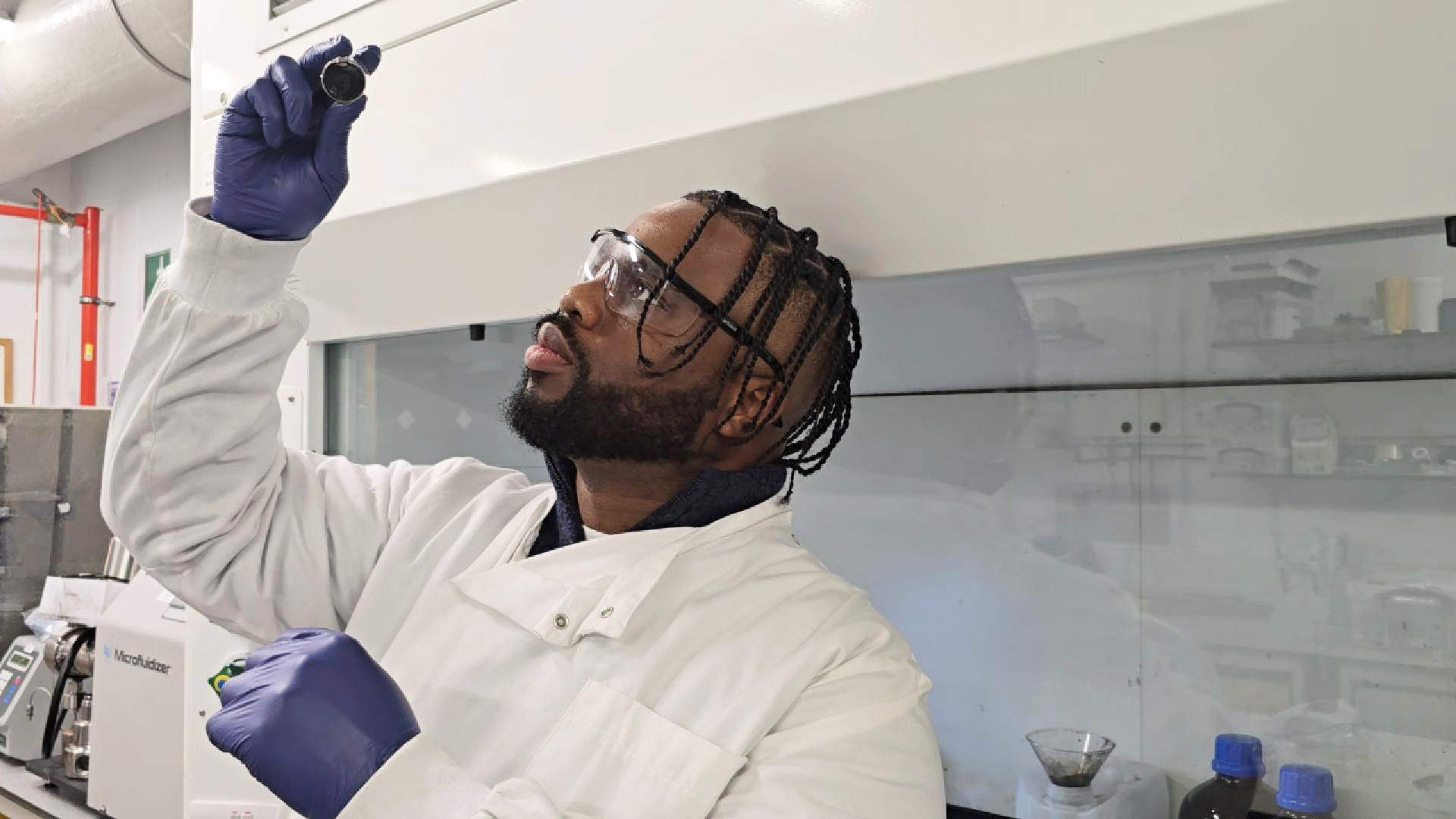
Credit: Dr Osarenkhoe Ogbeide
Creativity, outreach and inspiring future scientists
Alongside his scientific work, Dr Ogbeide is a talented illustrator and comic creator. Through his company, New Africa Comics, he writes and illustrates original stories that blend culture, imagination and social commentary, exploring themes of identity, discovery and resilience. His creative work informs his approach to science and has become a powerful tool for science outreach, transforming complex research into engaging visual narratives for schools and community programmes across the UK and globally.
Speaking about the fellowship, Dr Ogbeide said: “I am deeply honoured to receive this award from the Royal Society. It not only supports my research but also connects me with mentors and colleagues who are shaping the future of science. I hope my journey can inspire others from underrepresented backgrounds to see themselves in STEM.”
Professor Tawfique Hasan, who leads the Division’s research in advanced materials and nanotechnology, added: “This fellowship recognises Dr Ogbeide’s talent and the societal impact of his research. It is a tremendous achievement that will allow him to pursue ambitious ideas with real-world significance.”
Written by Michael Shuff.
This article first appeared on the Electrical Engineering at Cambridge website.
