

Spin-out companies from the Department of Engineering have received awards from the latest Trinity Bradfield Prize Competition.
Winning the Trinity Bradfield Prize is a huge vote of confidence in our approach to decarbonising concrete.
Dr Dushanth Seevaratnam
GreenMixes, founded by Callon Peate and Dr Dushanth Seevaratnam, of the Institute for Manufacturing (IfM), was awarded the £10,000 first prize for its carbon-negative concrete technology.
Pinepeak, set up by Dr Savvas Gkantonas and his former PhD supervisor Professor Epaminondas Mastorakos, won the £10,000 Angel Prize for its wildfire forecasting technology. The prize is awarded to finalists from the previous year who have made the most commercial progress.
Phaseshift, led by PhD student Phillip Cloud also received the Hellings Prize of £5,000 for its material-agnostic metasurface platform. This addresses critical challenges around miniaturisation and scalability in quantum technologies.
GreenMixes
GreenMixes has developed a proprietary drop-in biochar composite that can replace up to 15% of cement while maintaining full industrial strength. Concrete contributes a significant percentage of worldwide CO2 emissions, but with the new composite, it becomes a carbon sink with no capital expenditure or workflow disruption.
Callon, of Clare College, said: "We conceptualized the idea over a coffee at the Institute of Manufacturing, while discussing the scale of construction waste and emissions in rapidly developing countries such as India."Callon, a doctoral researcher, and research associate Dushanth developed the idea at the Department’s Institute for Manufacturing when discussing the scale of construction waste and emissions in rapidly developing countries such as India.
He added: ‘With our backgrounds in chemistry, nanoscience, and manufacturing, we believed we could engineer biochar specifically for cementitious systems rather than treating it as a generic filler – and that insight led directly to GreenMixes.
“This prize will enable us to increase production, conduct more pilot studies and increase validation studies."
Competition judges were impressed by the team’s technical depth, strong commercial prospects and the scale of impact their solution could deliver in addressing the climate crisis.
Dushanth, a bye-fellow at Churchill College, said: "Winning the Trinity Bradfield Prize is a huge vote of confidence in our approach to decarbonising concrete. It validates that scalable, non-disruptive solutions can play a real role in tackling one of the world’s hardest-to-abate industries. Concrete is everywhere, and that’s exactly why solving its carbon problem matters. This support will help us get GreenMixes into the hands of engineers, builders, and communities faster and start showing what carbon-negative construction can really look like.
Pinepeak
This company was born out of Savvas witnessing devastating wildfires, combined with jet engine research at the engineering department, used to create forecasting technology.
After seeing the devastation caused by the 2018 wildfire in Mati, Greece, co-founder and CEO Savvas and his former PhD supervisor, Epaminondas, of the Energy Fluids and Turbomachinery Division, decided to rethink wildfire modelling from first principles.
Savvas, a former Senior Research Associate at the department, said: “We wanted to know why some homes destroyed while others nearby remained virtually untouched. There were no tools available to accurately predict this.”

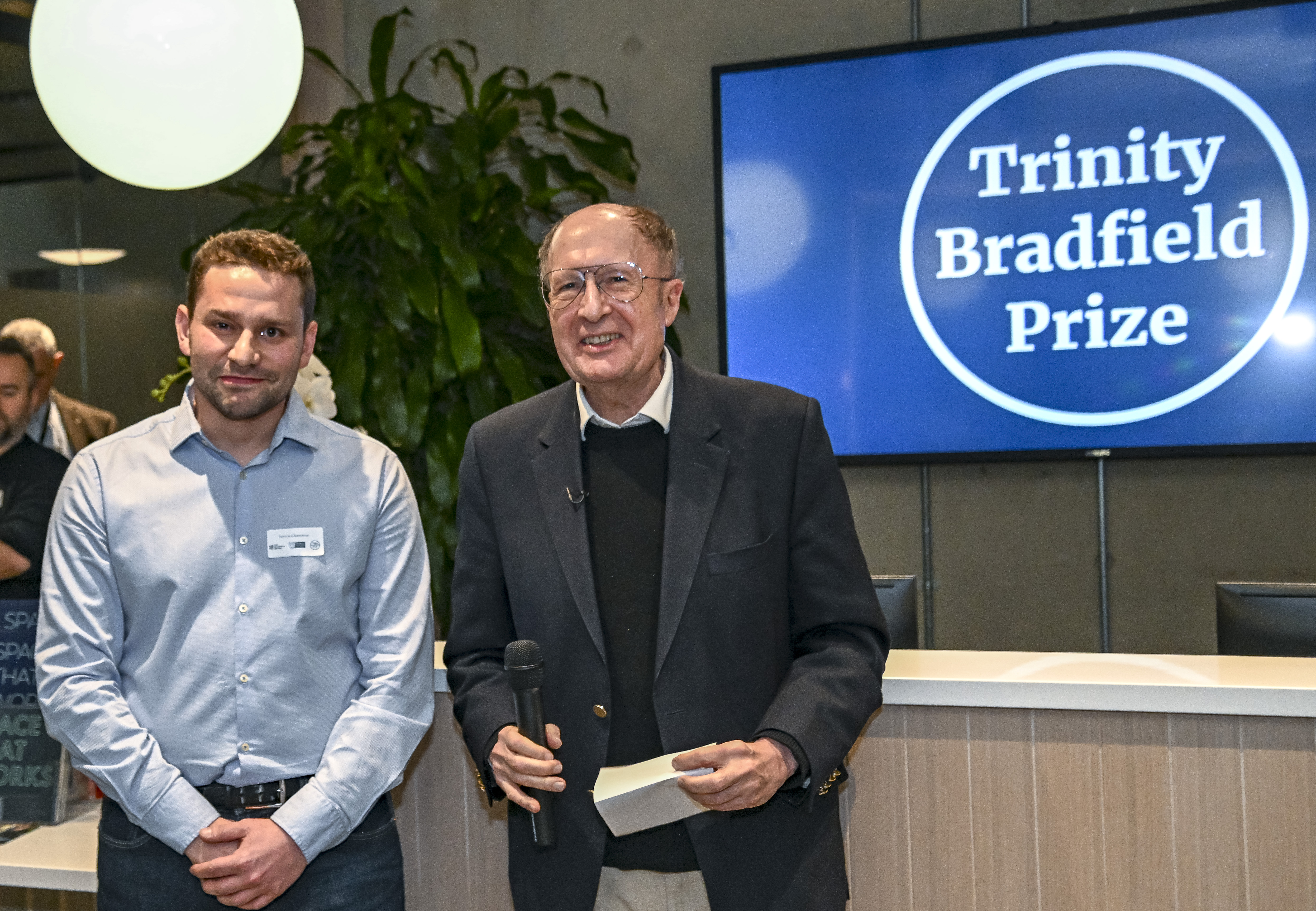
Savvas Gkantonas, of Pinepeak /Credit: Keith Heppell
Their novel solution journey based on academic research at Cambridge used their backgrounds in combustion science and AI.
He said: “FLAMESIGHT technology is a bit like weather forecasting, but for wildfires, looking at where and when they might start and how exactly they will behave next.”
‘By providing precise forecasts and analytics, down to the individual building, Pinepeak aims to improve re/insurance coverage. It will also strengthen community climate resilience and empower emergency responders in the fight against wildfires as risks evolve across the global built environment.”
Savvas, a former member of Trinity Hall and Churchill College, added: “Winning the Angel Prize is recognition of the progress we’ve made in turning a big, ambitious idea out of the lab into something that can solve real-world problems across multiple sectors.”
Read more about Pinepeak's story in our article Founders at Cambridge – where innovation meets action.
Phaseshift
Phaseshift, which is led in the UK by PhD student Phillip Cloud, of Darwin College, received the Hellings Prize for its material-agnostic metasurface platform. This addresses critical challenges around miniaturisation and scalability in quantum technologies.
The spin-out company develops advanced metasurfaces and integrated photonics for next-generation photonics applications. These include screens and cameras in smart phones, lighting in our homes and cars, and computer and television screens. This alternative breakthrough technology also has a wide range of uses in industries such as quantum sensing, display technology and biomedical imaging.
Phillip, who is based in the Agrawal Integrated Photonics Lab, of the department’s Electrical Engineering Division, said: ‘Our technology is to take traditional optical components which are big, bulky and require constant realignment and shrink them to a chip, offering 10-100x miniaturisation. We replace them with components – photonic integrated circuits (PICs) and metasurfaces.”

Sir Gregory Winter with Phillip Cloud /Credit: Keith Heppell
Co-founder Dr Amit Agrawal said the Trinity Bradfield Prize would help the company expand its customer base, protect its intellectual property, and generate funding for research and development.
