

Inspired by research that first introduced him to AI for the public good, alumnus Andrew Wang spent the next five years deepening his expertise in this field. He is now co-founder and Chief Technology Officer of Blur Labs, a start-up developing open-source foundation models for image reconstruction, with applications spanning from medical imaging to Earth observation.
Aside from academia, founding a deep tech start-up, in my opinion, is the most exciting way to use the engineering theory that I learnt at Cambridge. The collegiate system gave me unique opportunities to experience cutting-edge research before it was released and learn to build technology beyond surface-level applications of AI.
Alumnus Andrew Wang
It was during his Master of Engineering (MEng) degree at Cambridge that Andrew got the opportunity to join the Project Odysseus research team, assisting in the development and deployment of an AI vision-based monitoring tool for tracking social distancing decisions in London during the COVID-19 pandemic.
The award-winning tool – driven by digital twins, computer vision and large-scale data infrastructure – was presented to the Greater London Authority (GLA) and Transport for London (TfL). It provided near real-time data of social distancing adherence on the streets of the capital.
This was Andrew’s first foray into AI for the public good – and he wanted more.
“My second and fourth-year supervisor Professor Mark Girolami was responsible for sparking my interest in AI for scientific applications that benefit society, when he asked me to join him on Project Odysseus,” he explains.
“I then went on to study AI approaches to imaging inverse problems for my PhD at the University of Edinburgh, and it was while I was working on an open-source software project called DeepInverse, a deep learning library for image reconstruction, that I met two of its maintainers and co-creators, Julián Tachella and Matthieu Terris, and together we decided to launch Blur Labs.”
Introducing Blur Labs

A reconstructed medical volume is analysed in the clinic. This is a 3D digital dataset collected from an MRI scan. Credit: Blur Labs
Blur Labs, based in Paris, was spun out from an incubator at the Inria Saclay Centre in 2025. The trio are currently raising their pre-seed round and have created an open-source proof of concept called the Reconstruct Anything Model that is trained to solve a wide range of imaging inverse problems, such as deblurring, magnetic resonance imaging (MRI) and computed tomography (CT).
The research paper, which was presented by co-founders Julián (CSO) and Matthieu (CEO) at The Fourteenth International Conference on Learning Representations (ICLR 2026), in Rio de Janeiro, Brazil, earlier this year, details a series of experiments that demonstrate state-of-the-art performance from medical imaging to low-photon imaging and microscopy. Their model for computational imaging aids the reconstruction of high-quality images from limited or ‘noisy’ data. The team is now developing commercial products to bring this groundbreaking research to market.
Blur Labs’ mission is to harness AI to power the imaging devices of the future by removing the bottleneck – the cost of image acquisition. For example, in cancer imaging, Blur Labs aims to reduce waiting times for diagnosis and therapy by increasing scanner throughput (the rate at which patients are scanned). In routine imaging, Blur Labs aims to expand access to medical imaging by powering cheaper, portable hardware. In remote sensing, Blur Labs aims to push the boundaries of Earth observation from space by increasing image quality for a given satellite.
Tackling the bottleneck
Andrew (Christ’s College 2018) explains: “The bottleneck in almost all scientific, medical and industrial applications lies not in what you do with images, but how you acquire and reconstruct images in the first place. This is because there is a trade-off between the cost of image acquisition and how high quality your images are.
“For example, in medical imaging, every minute a patient spends in the scanner for an MRI or PET (positron emission tomography) scan costs the hospital money, yet each additional minute improves the image quality. Similarly, high-quality images can be obtained with expensive, bulky hardware, which is impractical for remote sensing where every gram of satellite payload matters.
“Deep learning for image reconstruction has promised to surpass this trade-off and decrease the cost of imaging while increasing image quality, and there are a handful of such products on the market today. However, we know from speaking to people like radiologists that they still fail in practice because they are fragile i.e. failures occur whenever one acquires an image out of the training distribution of the algorithm.”
A new paradigm for image reconstruction
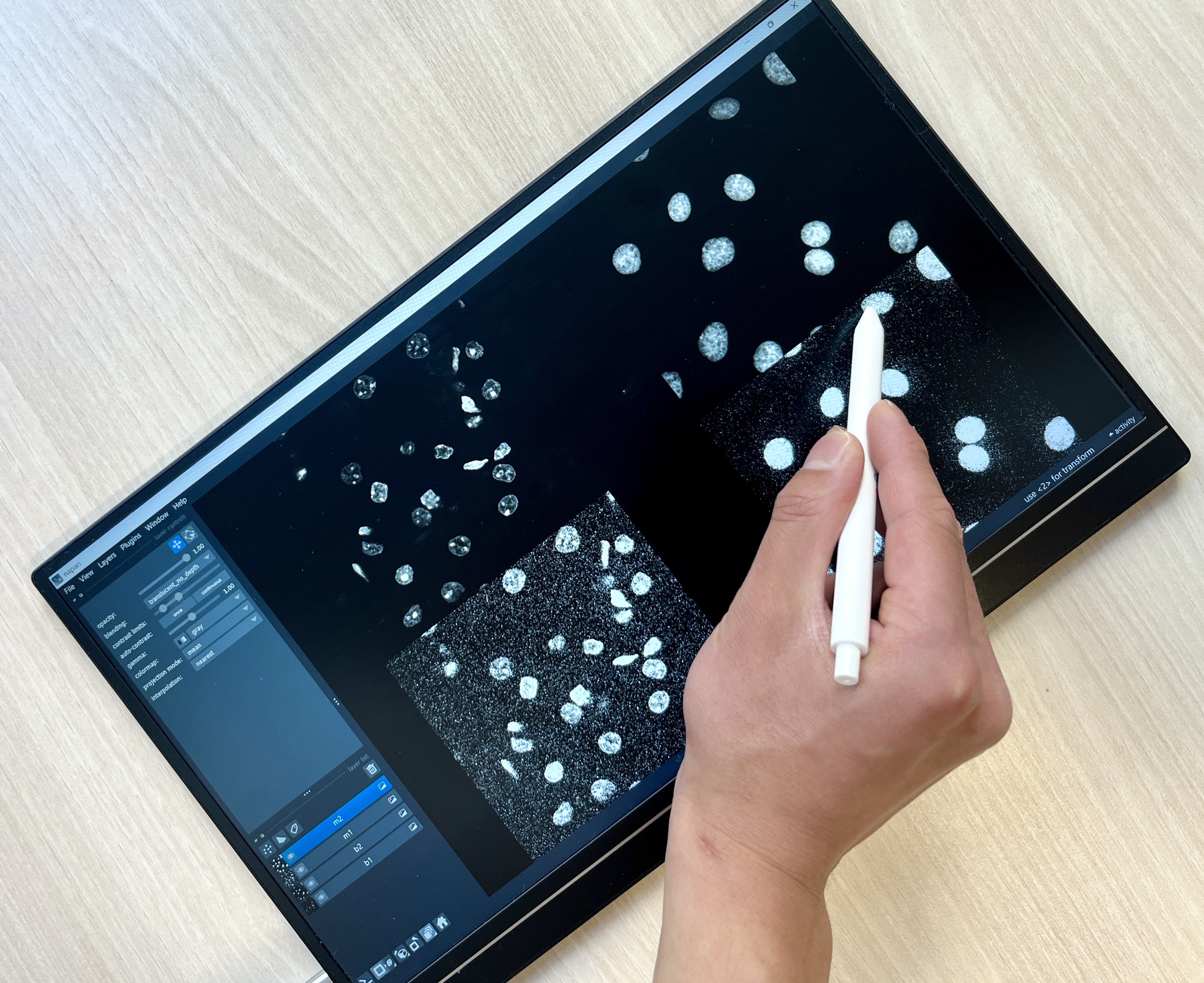
Microscope images are restored and analysed. Credit: Blur Labs
“At Blur Labs we are solving this problem,” says Andrew. “We propose a new paradigm for image reconstruction and have developed the first foundation models for image reconstruction.”
Foundation models are robust algorithms that Blur Labs pretrain across millions of images and scanners. This way, says Andrew, they can deploy the algorithm to customers' specific setups without needing to retrain on swathes of proprietary customer data every time.
He adds: “Our product is AI software that is integrated into existing and future hardware to maximise the value of the imaging device.
“We are now training the next generation of foundation models that push image quality even further. The open source allows us to benefit from a community of domain experts around the world who build imaging systems day-to-day in academia and industry. As a deep tech start-up, we maintain open-source tools to make it easier for these experts to use state-of-the-art AI tools.”
From academia to start-up success
For Andrew, who specialised in Information and Computer Engineering for his MEng, his experience at Cambridge helped to set him up for his future endeavours and introduced him to the fundamentals of machine learning and computational statistics.
“Aside from academia, founding a deep tech start-up, in my opinion, is the most exciting way to use the engineering theory that I learnt at Cambridge.
“I was privileged to be taught the fundamentals of machine learning and computational statistics by great professors at Cambridge. The collegiate system gave me unique opportunities to experience cutting-edge research before it was released and learn to build technology beyond surface-level applications of AI.”
He added: “College life meant that I had friends from around the world who studied not just engineering but linguistics, music and medicine. It taught me the importance of staying social and learning from others outside of engineering.
“Now, as a co-founder of a start-up on the global stage, I find that technical skills are just as important as being able to form connections with people with different roles and from different backgrounds. This is especially true with regards to learning foreign languages.
“While at Cambridge, I spent a lot of time at the Department of Engineering’s Centre for Languages and Inter-Communication (CLIC) studying French and German, and I went on an exchange with a university in Paris, followed by a remote research internship with the same university in my third year. The Centre, directed by Professor David Tual, is unique in the UK in emphasising the importance of intercultural communication for engineers. Whether speaking to European investors or selling to international customers, these skills have been instrumental in my role today as Chief Technology Officer at Blur Labs.”
