
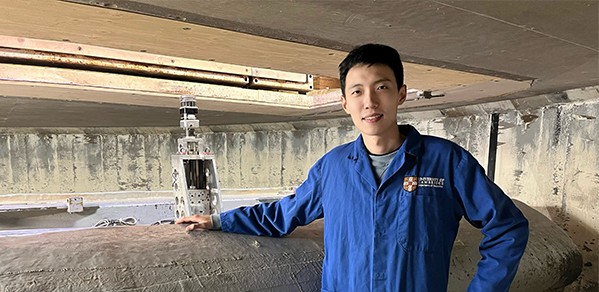
PhD student Zhijun Xu has been awarded the Department of Engineering’s 2025 Turner Prize for his innovative contributions to geotechnical centrifuge modelling.
Deep excavations commonly induce soil deformation and ground settlement, posing risks to nearby structures. Traditional retaining systems rely on props that limit site operations and are not environmentally efficient.
PhD student Zhijun Xu
Zhijun’s award was for his development of innovative apparatus for modelling excavations in clay. This assesses the impact of soil deformation and ground settlement from deep excavations on nearby structures, such as buildings, bridges and roads.
The Turner Prize honours the late Philip Turner, a mechanical engineer in the Department of Engineering, known for designing pioneering devices including the 10m-diameter beam centrifuge. This annual research student prize is presented for outstanding work in geotechnical centrifuge testing at the Schofield Centre, which is part of the Civil Engineering Division.
Professor of Civil Engineering, Gopal Madabhushi, presented Zhijun with the prize and said: “Zhijun’s work demonstrates strong experimental capability and offers valuable insights into the performance of novel excavation retaining systems.
“Conducting complicated model tests intended for normal gravity conditions in a 100g centrifuge environment requires meticulous planning and the ability to respond quickly to unforeseen challenges.”
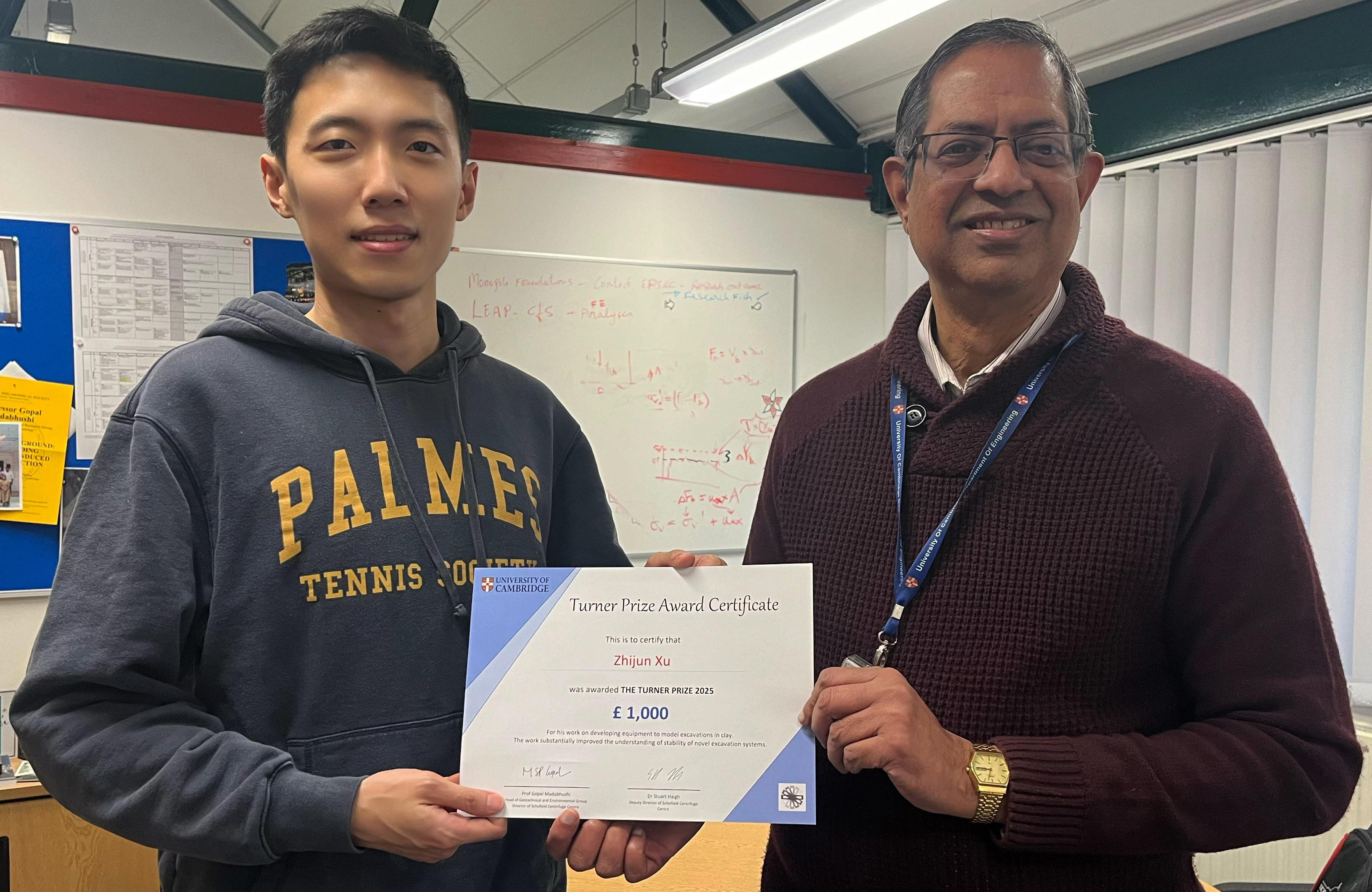
Professor Gopal Madabhushi (right) presents PhD student Zhijun Xu with the Department’s Turner Prize. Credit: Diarmid Muchen Xu
Zhijun’s PhD research topic is "Behaviour of Novel Retaining Systems for Excavation in Clay". He is investigating Inclined Retaining Walls (IRW) and Inclined–Vertical Framed Retaining Walls (IVFRW). This research has been carried out with the Geotechnical and Environmental Research Group, under the supervision of Professor Stuart Haigh.
“Deep excavations commonly induce soil deformation and ground settlement, posing risks to nearby structures. Traditional retaining systems rely on props that limit site operations and are not environmentally efficient,” said Zhijun.
“Recent studies indicate that IRWs and IVFRWs can reduce wall deflection and enhance overall stability, yet their mechanical behaviour remains insufficiently understood. Since full-scale testing is impractical, centrifuge modelling is essential for investigating these systems under realistic stress conditions.
Conventional centrifuge excavation modelling methods, such as pre-excavation at 1g (normal earth gravity), heavy fluid drainage, and removal of soil bags, present significant limitations. To address these issues, Zhijun’s innovative modelling apparatus provides a flexible, continuous, and robust means of simulating excavation under high g-levels. In geotechnical centrifuge tests, high g-levels reproduce the realistic stress conditions of a full-scale prototype in a small-scale model.
The device uses the in-flight excavation method with a newly integrated system and overcomes the shortcomings of previous approaches. By enabling the modelling of excavations supported by novel retaining structures, this advancement forms the basis for further research on IRW and IVFRW behaviour.
