
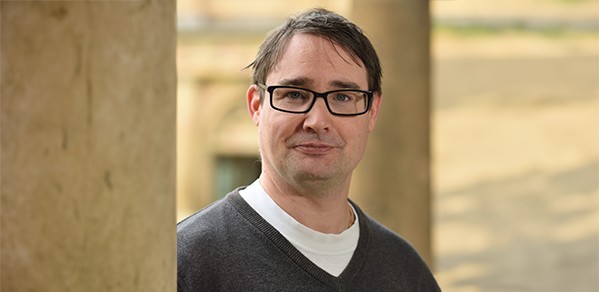
A pioneer of Human-Computer Interaction, whose research is creating more accessible and satisfying technology for us all, has won an international award for his impact.
Put simply, I build systems that amplify people's ability to effectively and efficiently interact with computer systems.
Professor Per Ola Kristensson
The results of Professor Per Ola Kristensson’s research can now be seen in mobile phones and virtual and augmented reality devices. By allowing us to control IT with a gesture or a character, we have faster and more reliable ways to communicate. This brings a range of benefits from faster gaming and typing, through to providing a greater accessibility for people who have limited speech or mobility.
His significant, cumulative contributions to the development of this field have been recognised by the Association for Computing Machinery (ACM). It has honoured Professor Kristensson by inducting him into the ACM SIGCHI Academy. The distinction highlights remarkable achievements in scholarship, service, mentorship, and impact within the Special Interest Group on Computer-Human Interaction.
Professor Kristensson will be presented with this award at the 44th ACM Conference on Human Factors in Computing Systems (CHI 2026), in Barcelona, in April.
Professor Kristensson, a Professor in Interactive Systems Engineering, said: “Put simply, I build systems that amplify people's ability to effectively and efficiently interact with computer systems. Artificial intelligence has always played a large role in designing such interfaces. It is interesting to see how interaction technology capabilities have evolved in response to the rapid progress in machine learning.”
Professor Kristensson is also one of the co-authors of the first comprehensive book on this subject titled Introduction to Human-Computer Interaction (Oxford University Press). This open access title has the main theme of “human-centredness” and is already being used as a teaching aid.
He said: “The noble goal of human computer interaction research is to help create computing that supports the betterment of humankind. Taking human-centeredness seriously is essential for understanding and improving the use of technology in society. What does this mean in practice and how can we make this maxim actionable?
“Great efforts have been made throughout history to innovate and refine our tools, but the birth of the computer marks a watershed. Computing has had a pervasive impact on our thinking, our values, how we play and even how we build and maintain social relationships, including romantic relationships. Computers have shaped our economies, leisure, transportation patterns, social networks, and even elections and wars.”
He added: “But computers would be useless as tools if they did not offer a way for people to control them. The user interface allows us to control and interact with the computer, without needing to know about what goes on under the hood. For example, instead of defining a long binary code that commands a microprocessor to delete a file, the command can be provided with a few mouse movements and clicks, or even with a gesture.”
Professor Kristensson, a fellow of Trinity College, co-invented gesture keyboard technology, also called gesture typing, before and during his PhD thesis. He then commercialised this through the company Shapewriter Inc, while he was a Junior Research Fellow at Darwin College. This technology is now available on all mobile phones and many virtual and augmented reality devices, and allows text to be inputted without lifting our fingers from keyboards. It is one of the most impactful innovations in human-computer interaction with an estimated 250 million active users globally.
His research now covers intelligent interactive systems, human-computer interaction, virtual and augmented reality, accessibility, inclusive design, augmentative and alternative communication and interaction science.
By analysing how we interact with technology, he is improving our experience of the real and virtual world. His research was used to create a gaze-based input for non-speaking people with motor disabilities, manufacturable exoskeleton gloves for virtual reality interaction, and a headset that allows users to type without a keyboard.
What are the next developments in this evolving field?
“The next challenge is to enable control of artificial intelligence immersed within physical environments, including control of personal robotics and even our own bodies,” he said. “I see great potential in extended reality and body augmentation to allow us to seamlessly communicate in the physical world with virtual content and pervasive artificial intelligence.”
