
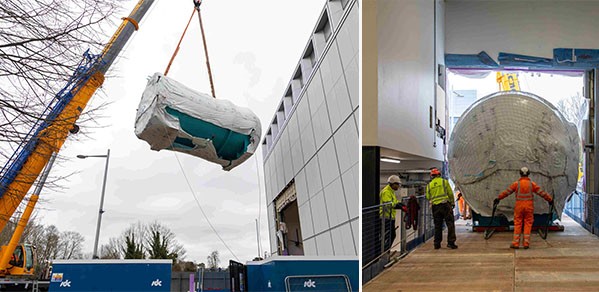
A 60-tonne pressure vessel was installed at the heart of Cambridge’s new National Centre for Propulsion and Power (NCPP), located within the New Whittle Laboratory – and with it, a genuinely new kind of engineering capability arrived in the UK.
The facility, funded by the Aerospace Technology Institute (ATI), Innovate UK, and the Department for Business and Trade, needed four lorries, a journey from Spain, and the planned temporary removal of a section of the building to get it here.
But what the NCPP will unlock is far more significant than the logistics:
- A faster journey to hardware technologies
Formula 1 teams dominate the grid by fusing design, manufacture and testing into a single, continuous loop – iterating at the speed of human creativity. The NCPP’s new 4MW rapid test facility brings that same philosophy to aerospace, energy and defence – compressing the journey from concept to physical test, from years to weeks.
- Embodied AI that learns from the physical world
Most AI learns from the internet – ours will learn from reality. The NCPP will provide the unparalleled volumes of aerothermal data needed to train an aerothermal world model, closing the gap between digital simulation and reality.
By giving the UK unparalleled speed in taking hardware technologies to demonstration, Cambridge is creating a compelling reason for start-ups, scale-ups, and global firms to develop their most critical technologies here, not overseas – generating new industries, high-value jobs, and long-term economic growth. Built in the UK, for the UK.
If the hardware industries of the future are to be built in the UK, we must be capable of taking technologies to demonstration at unprecedented speed.
On loan – the world's most fuel-efficient large aero engine
The facility also took delivery of a Rolls-Royce Trent XWB – the world’s most fuel-efficient large aero engine. On loan from Rolls-Royce, it will be visible through the feature viewing window at the gateway to the Cambridge West Innovation District – a symbol of what decades of partnership between UK academia and industry can achieve.
Thanks to the team at SDC for the precision engineering that made this installation possible.
The New Whittle Laboratory – a world-leading facility
Building work on the New Whittle Laboratory will be completed in 2026. The world-leading facility will be home to the UK's next generation of clean-energy and aviation innovation, bringing researchers and industry engineers together under one roof to tackle some of the toughest challenges in aviation, energy and defence.
This article first appeared on the University of Cambridge website.
