

Researchers from and affiliated to the Department of Engineering will work with local government to advance AI innovation in public services.
By working directly with councils and embedding public input throughout, we are creating the conditions to develop AI systems that respond to real operational challenges and deliver meaningful improvements for communities.
Professor Neil Lawrence, Chair of ai@cam
The inaugural Local Government AI Accelerator, launched by ai@cam – the University of Cambridge’s flagship mission on AI – is a programme that establishes a new model for how universities and local government can work together, developing practical, proof-of-concept AI solutions to real operational challenges, and delivering meaningful improvements for communities.
Funded by the Ministry of Housing, Communities and Local Government (MHCLG), the 12-month Accelerator pairs Cambridge researchers directly with local councils to develop a range of AI solutions that deliver tangible public value, from automating housing data collection to detecting fly-tipping using cameras on refuse vehicles. The programme places public concerns directly into the research process.
The Accelerator was shaped by insights from a workshop held in November 2025, where 21 local authorities shared their most pressing operational challenges, highlighting the significant potential for AI to provide practical support. These discussions brought into sharp focus the pressures facing councils:
- Residents navigating fragmented services.
- Vulnerable people at risk of falling through gaps in provision.
- Staff burdened by manual administrative work.
The Accelerator has been designed to respond directly to these challenges, with six projects selected in total, three of which involve researchers from and affiliated to the Department of Engineering, and are listed as follows:
- SHIFT: AI-enabled Surveys for Housing Intelligence and Future Trajectories
- Deep Learning for Fly-Tipped Waste Detection
- Human-Oriented AI: Design Framework for Reaching Vulnerable Tenants
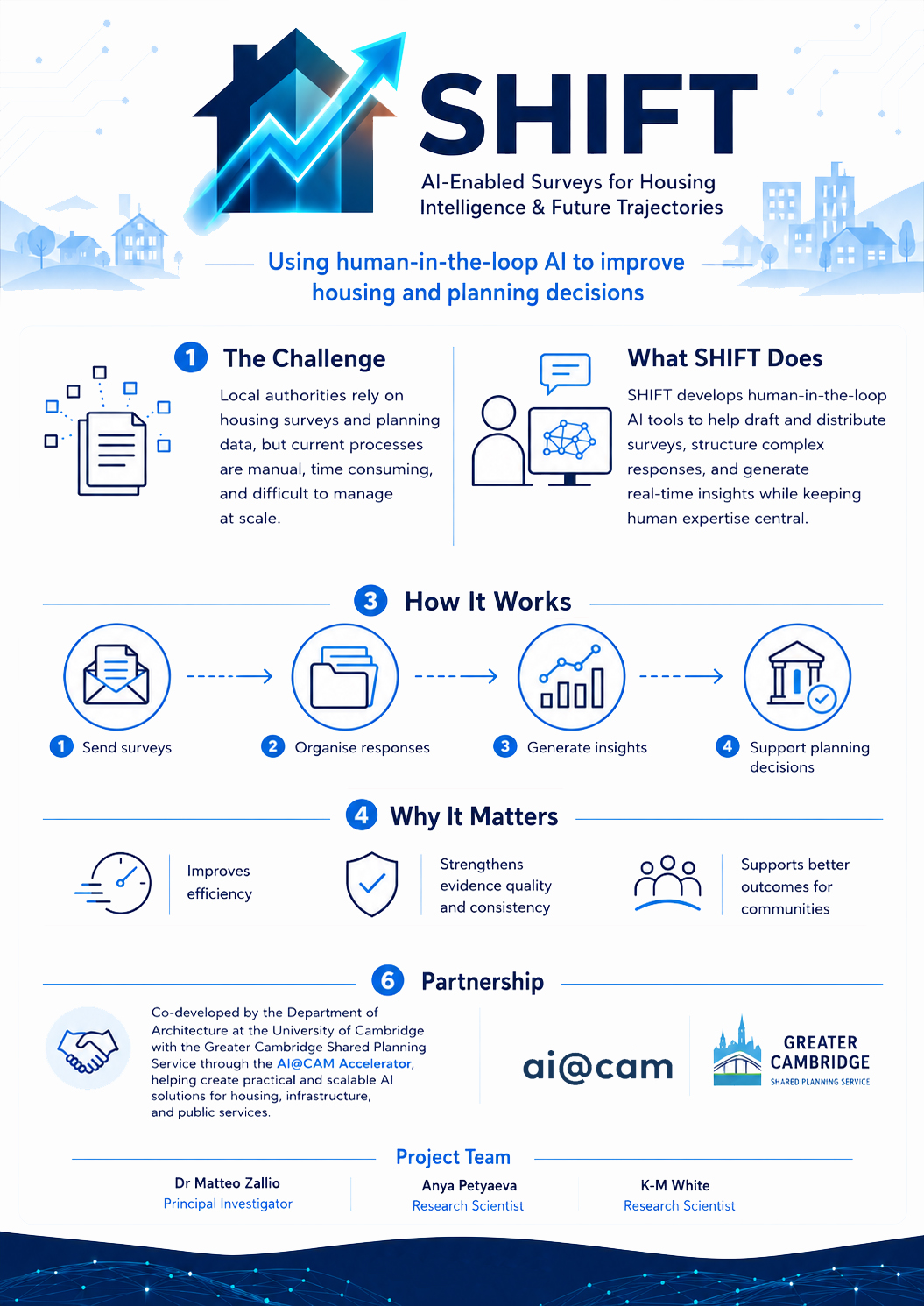
SHIFT: AI-enabled Surveys for Housing Intelligence and Future Trajectories
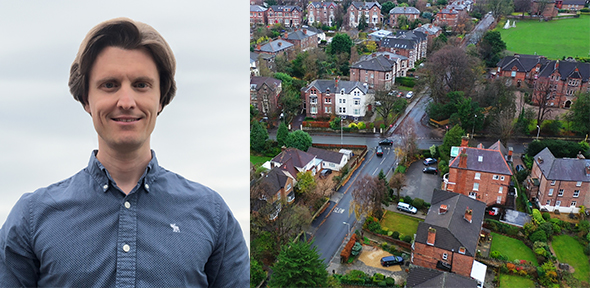
Principal Investigator Dr Matteo Zallio. Credit: [RIGHT] ink drop – stock.adobe.com
Overview: Preparing the annual housing trajectory is a statutory requirement for all English local authorities, yet the process of distributing, chasing and analysing site-specific questionnaires sent to developers and housebuilders remains highly manual and time-consuming.
This project will develop a human-in-the-loop AI-enabled workflow to automate questionnaire drafting and distribution, convert free-text responses into structured data, and provide live monitoring dashboards for planning officers.
By freeing officers from repetitive administrative tasks, the project aims to deliver faster and more consistent housing delivery evidence, improve the experience for external respondents, and produce an open, reusable framework that other local authorities can adopt.
Principal Investigator: Dr Matteo Zallio (University of Cambridge), Assistant Professor in Architecture and Design at the Department of Architecture, and Co-Lead of the Inclusive Design Group at the Department of Engineering.
Council Partner: Greater Cambridge Shared Planning Service (Cambridge City Council and South Cambridgeshire District Council).
Dr Zallio said: “This project represents an important opportunity to strengthen collaboration between the University and local government by using ethical AI to support evidence‑based design and planning.
“I’m particularly excited about developing human‑in‑the‑loop AI tools that reduce administrative burden for planning officers while improving transparency, consistency and the overall experience for external contributors. The ambition to create a scalable and reusable framework that local authorities can adopt is especially meaningful to me.”
Deep Learning for Fly-Tipped Waste Detection
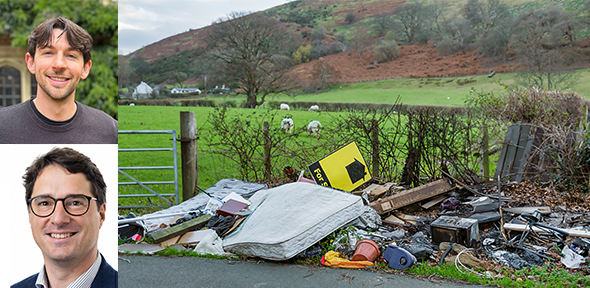
Principal Investigators Tyler Holderness (top left) and Dr Florian Urmetzer. Credit: [TOP LEFT] Trinity Hall. [RIGHT] alan1951 – stock.adobe.com
Overview: Fly-tipping places a significant financial and environmental burden on local authorities, with more than 1.15 million incidents recorded across England in 2023/24 alone.
This project will develop a deep-learning computer vision pipeline that leverages cameras already fitted to refuse collection vehicles to detect fly-tipped waste during routine rounds. The system will automatically extract the location, timestamp, waste description and photographic evidence needed to generate a report, with human-in-the-loop verification before any action is taken.
By converting an existing but underutilised data asset into a proactive detection tool, the project aims to reduce the reporting burden on the public and accelerate the resolution of incidents.
Principal Investigators: Dr Florian Urmetzer, Associate Teaching Professor, and Tyler Holderness, Doctoral Researcher, both from the Institute for Manufacturing (IfM), University of Cambridge.
Council Partners: South Cambridgeshire District Council and Greater Cambridge Shared Waste Services.
Dr Urmetzer and Tyler Holderness said: “It is a rare treat to apply technology in such an immediate, tangible way. With refuse collection vehicles woven into the fabric of our communities, this project has real potential for making a positive impact. We are excited to be working on something that is both interesting from a research perspective but also beneficial to our city.”
Human-Oriented AI: Design Framework for Reaching Vulnerable Tenants

Principal Investigator Dr Viviana Bastidas Melo. Credit: [LEFT] Studio Romantic – stock.adobe.com
Overview: As local authorities develop AI-powered tools to support vulnerable tenants, there is a risk that technical development moves faster than the governance, ethical and public value frameworks needed to ensure those tools are legitimate and trustworthy.
This project will apply our Human-Oriented AI framework to the early warning system being developed by Cambridge City Council and South Cambridgeshire District Council. Human-Oriented AI is a framework designed to orient AI-based systems toward human and societal needs, with governance as the means to ensure that systems realise the intended public values.
The project will produce modelling scenarios for AI architectures, and an architecture vision and roadmap by instantiating our Human-Oriented AI framework. This work will allow us to co-design with stakeholders how governance, public value, ethics and technical requirements can be shaped together in a concrete institutional setting. These practical artefacts can then serve as a blueprint for responsible AI adoption across the housing sector and, potentially, across other public sector domains, putting people and public responsibility at the centre of AI deployment.
Principal Investigator: Dr Viviana Bastidas Melo (University of Cambridge), Assistant Research Professor in Urban Systems and Infrastructure.
Collaborator: Professor Jennifer Schooling, Anglia Ruskin University (ARU).
Council Partners: Cambridge City Council and South Cambridgeshire District Council.
Dr Bastidas Melo said: “For me, this partnership is what makes this work meaningful. It brings together our research on responsible AI with the real-world expertise of local government in supporting tenants. I hope we can show that digital innovation and strong governance, ethics, and public value can be aligned and advanced together.
“The project will apply a socio-technical lens to its early warning systems and produce architecture artefacts that embed those requirements into design decisions. At its core, Human-oriented AI is about putting people at the centre of the design of AI-based systems, so that stakeholders can share a common understanding and reflect on the potential impacts of those systems on our society, making housing support more connected, responsive and responsible.”
Scaling impact across local government
Each project will receive up to £25,000, dedicated technical support from machine learning engineers, and access to a structured community of practice (CoP). The findings will be shared through ongoing engagement with councils, residents and policymakers. A final showcase will highlight lessons learned and opportunities for wider adoption across the local government sector.
The Accelerator forms part of ai@cam’s broader mission to drive a new wave of AI innovation that delivers tangible public value through collaboration between academia, government and society.
“This programme is about moving beyond experimentation to understanding what works in practice,” said Professor Neil Lawrence, DeepMind Professor of Machine Learning and Chair of ai@cam. “By working directly with councils and embedding public input throughout, we are creating the conditions to develop AI systems that respond to real operational challenges and deliver meaningful improvements for communities.”
South Cambridgeshire District Council’s Lead Cabinet Member for Corporate Services, Councillor Ed Sanders, said: “Truly understanding the potential for the safe, ethical and effective use of AI and related new technologies in improving public sector services is clearly a process which is in its infancy. These are exploratory projects, from tackling fly-tipping to better understanding housing needs and supporting vulnerable tenants, and we’re proud to be working alongside the University of Cambridge in breaking new ground in this field. Proceeding in the spirit of positive innovation, but with rigour and caution, it is my hope that collaborations like this can yield these and many more practical and ethical improvements for our communities.”
Councillor Katie Thornburrow, Leader of Cambridge City Council and Cabinet Member for Strategy, Planning and External Partnerships, said: “We’re proud to be working with the University of Cambridge on this innovative programme. It’s a fantastic opportunity to explore how AI can be used in a responsible and practical way to improve key local services. Whether it’s identifying housing issues earlier, or streamlining planning processes, these projects are focused on delivering better outcomes for our communities. This is about equipping colleagues with clearer insights to make more informed and confident decisions – decision-making will remain firmly in human hands, not AI.
“We look forward to seeing the results and understanding how the ethical use of emerging technology can help us work more efficiently, while ensuring our staff can focus on what matters most – supporting our residents.”
Adapted from an ai@cam news article.
