
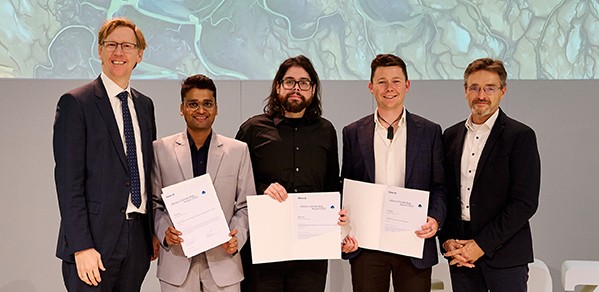
PhD student Shagun Garg, whose research focuses on improving the detection and mapping of floods in arid and semi-arid regions, has been named as a top three finalist in the 2025 Allianz Climate Risk Award.
I’m delighted to have been named a finalist and to be among such a strong group of researchers. It was inspiring and highly motivating to learn about the breadth of work being done in climate risk.
PhD student Shagun Garg
Now in its ninth year, the Award celebrates scientists at the start of their career whose work sheds light on the nexus between climate change and extreme weather events.
Shagun was one of three finalists invited to present his research titled Advancing flood and water risk monitoring in arid regions using satellites and machine learning in front of a jury. His presentation (see pages 24-25) highlighted the growing climate risk challenge of assessing flood risk in arid regions, and the need for improved monitoring tools, as this is an area where traditional satellite-based monitoring tools often fail.
Shagun’s research proposes new approaches for identifying and quantifying flood extent in drylands, with direct relevance to insurers, policymakers and communities facing increasingly unpredictable climate extremes.
His research, supervised by Dr Sakthy Selvakumaran and Dr Edoardo Borgomeo, sits at the intersection of Earth observation and water management, focusing on the mapping and monitoring of floods using satellite data. His work also explores how evidence-based, nature-based solutions can help reduce water-related disaster risk and build climate resilience.
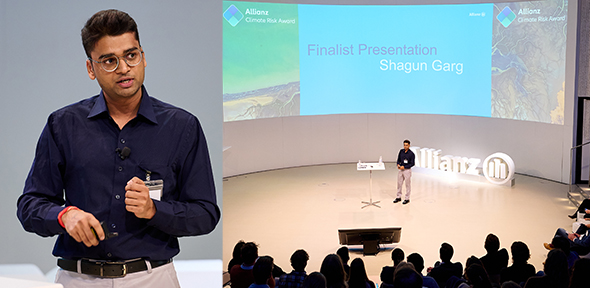
PhD student Shagun Garg delivers a presentation on his research in front of a jury. Credit: Allianz
Shagun joins the Department as part of the EPSRC Centre for Doctoral Training in Future Infrastructure and Built Environment: Resilience in a Changing World (FIBE2 CDT) programme. He said: "I’m delighted to have been named a finalist in the Allianz Climate Risk Award and to be among such a strong group of researchers. It was inspiring and highly motivating to learn about the breadth of work being done in climate risk.
"I loved seeing how scientific research can be translated into practical decision-making. There was a strong focus on real-world applications and how these tools can help insurers and communities prepare for future climate risks."
Speaking at the time of the award ceremony, Holger Tewes-Kampelmann, CEO of Allianz Reinsurance, underscored the importance of scientific research in addressing climate change: "The scientists we celebrate with the Allianz Climate Risk Award help to shift our focus from isolated events to interconnected systems, proving that resilience isn't just measurable – it is designable and precisely targetable."
Adapted from an Allianz media release.
