
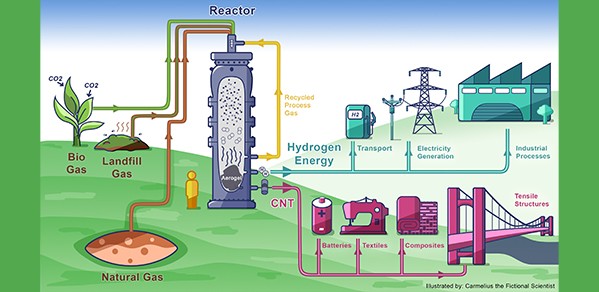
Researchers have successfully converted methane (natural gas) into hydrogen with low CO2 emissions alongside high-performance carbon nanotube (CNT) materials. These CNTs can act as sustainable replacements for CO2-intensive materials such as steel, aluminium and copper.
By recycling gases inside our reactor in a multi-pass configuration, we were able to produce hydrogen and CNTs at the same time. The CNTs possessed similar properties to those made in a conventional reactor, with the efficiency being many times higher.
Co-author Jack Peden
The process is made possible thanks to a research team from the University of Cambridge and Stanford University who modified a continuous-flow reactor to make it more efficient, but, crucially, without compromising the quality of the versatile and high-value nanotubes.
Hydrogen is sought as a sustainable fuel to aid in the decarbonisation of industries that are hard to electrify, like aviation and shipping. The world already produces 100 million metric tons of hydrogen per year, primarily as a feedstock for industrial processes like ammonia production, which is used for artificial fertilisers. This hydrogen production relies heavily on steam methane reforming of natural gas, which is a very CO2-intensive process, contributing 2-3% of global greenhouse gas emissions.
But now, researchers present technology that has the potential to be scaled up for real-world use, providing an opportunity to produce sustainable fuel and materials from a single process. This process could be a key enabling step for methane pyrolysis, by which methane is converted into turquoise hydrogen, resulting in solid carbon, therefore avoiding the creation of CO2. The results are reported in the journal Nature Energy.
The researchers’ continuous-flow reactor uses a highly versatile and scalable technique known as floating catalyst chemical vapour deposition (FCCVD) – a process that enables the continuous mass production of CNTs, which take the form of mats, fibres and aerogels. These CNT materials can be stronger and lighter than steel, as well as being good conductors of electricity and heat. This combination of properties makes them suitable to displace current materials in a range of applications such as batteries and textiles.
However, the FCCVD process has historically consumed hydrogen, rather than produced it.
“We were able to overcome this problem by recycling gases inside our reactor in a multi-pass configuration, which allowed the production of hydrogen and CNTs at the same time,” said co-author Jack Peden, a PhD student at the Department of Engineering, University of Cambridge, and a Harding Distinguished Postgraduate Scholar.
“The nanotubes produced in the multi-pass reactor possessed similar properties to those made in a conventional reactor, with the efficiency being many times higher than the conventional one.”
He added: “Meeting today’s hydrogen demand of 100 million metric tons per year using methane pyrolysis would produce 300 million metric tons per year of solid carbon. Only a few materials are currently used on this scale: typically, structural materials like concrete (16,000 million metric tons per year), steel (1,600 million metric tons per year), and plastics (350 million metric tons per year).
“To enable the meaningful scale up of methane pyrolysis, it is thus essential to produce carbon materials which can be used in these kinds of applications.”
Co-author James Elliott from the Department of Materials Science and Metallurgy, University of Cambridge, said: “By capturing and recycling the gases within the reactor and optimising the furnace design, we have significantly reduced the energy required to run the process.
“The carbon nanomaterials produced already show promise in batteries and textiles, and could in future be used in lightweight composites, building materials or high-voltage electrical cables. Because these materials have substantial economic value, their sale can offset operating costs, making methane pyrolysis a commercially competitive route to low-carbon hydrogen.”
This research was funded by the UKRI and EPSRC as part of the Global Hydrogen Production Technologies (HyPT) Center, along with the Carbon Hub, and the Kavli Foundation Exploration Award in Nanoscience for Sustainability.
Reference:
J. Peden; J. Ryley; J. Terrones; F. Smail; J.A. Elliott; A.H. Windle; A.M. Boies. ‘Production of hydrogen and carbon nanotubes from methane using a multi-pass floating catalyst chemical vapour deposition reactor with process gas recycling’. Nature Energy (2025). DOI: 10.1038/s41560-025-01925-3
