
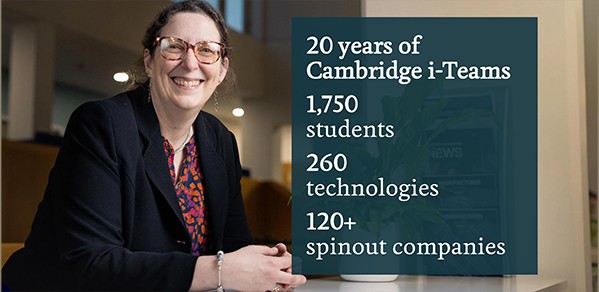
Following a successful exit from an internet technology start-up, Amy Weatherup has become a pillar of the Cambridge innovation ecosystem as Director of Cambridge i-Teams, an investor at – and now co-chair of – Cambridge Angels, and a tireless supporter of an array of businesses, schools and charities in and around Cambridge.
You have to be able to cope with uncertainty if you are an entrepreneur. It is the nature of the beast that you can do everything right and still fail. If you are going to struggle with that uncertainty, it may not be the right path for you.
Amy Weatherup
It’s been 20 years since the first Cambridge i-Teams session took place – a programme which continues to shape the next generation of innovators. Bringing together entrepreneurial post-grads and early career researchers to explore the commercial potential of cutting-edge University inventions, Cambridge i-Teams, which runs termly, is open to students and staff from all University disciplines. There are four options available: Innovation i-Teams, Medical i-Teams, Social i-Teams and Development i-Teams.
In this interview, Amy, who is based at the Institute for Manufacturing (IfM), part of the Department of Engineering, reflects on her entrepreneurial journey, the evolution of the Cambridge i-Teams programme, and shares her insights into how Cambridge’s innovation landscape has transformed over the past two decades, with commercialisation now firmly embedded in its culture.
“Everything I do is about creating the space for people to bring their own ideas and fulfil their potential,” says Amy.
From maths to start-up success – the early days
I did a maths degree at Cambridge, then started Part III Maths which I left halfway through for a PhD in fluid mechanics at Imperial, which I left halfway through to found a start-up. You can see a pattern emerging!
My start-up was called STNC, which ended up being the first company in the world to put web browsers onto mobile phones. When we started in the early 1990s, mobile phones were becoming a thing but only for voice calls and text messages. They certainly didn't have colour displays, cameras or email.
My co-founder was one of the very few experts in computer networking at the time and we started offering a solution for email for low-cost, low-power hand-held devices.
We would go to meetings and people would say things like: "Why on earth do we need email when we've got a perfectly good fax machine? Who wants to send an email from their phone?"
We grew very slowly to start with and then the internet happened, almost overnight.
We were one of the few companies in the world that understood its possibilities. By that stage, there were 10 of us and we had some of the world's largest tech companies queuing at our door.
Two things happened in parallel. Everyone wanted to get on the internet and mobile phones started to carry small amounts of data.
We were able to create a web browser that used less than 200 kilobytes and found ourselves in a unique space, doing something that no-one else could, just as the internet was bursting into everyone's lives.
We decided to take external investment to ride the opportunity. From then on, we were doubling in size every year.
We started to work with Microsoft which eventually led to them acquiring us and our software becoming Microsoft Mobile Explorer.
The evolution of Cambridge i-Teams
I found myself a role in the University as Entrepreneur-in-Residence at the Cambridge-MIT Institute, a partnership between the two universities that ran from 2000 to 2006. It was then that I came across MIT's i-Teams programme and started to think about how it could work for Cambridge.
At the time, there was quite a lot of support available for students who already had an idea for a business and there were a couple of undergraduate courses and some masters' programmes which included modules on entrepreneurship. But there was very little for the majority of students who were broadly interested in entrepreneurship but didn't have their own idea for a company.
Cambridge i-Teams was designed to fill that gap by giving entrepreneurial students the opportunity to work on real technologies coming out of the University that were underpinned by great science.
Teams of up to seven participants, from across all University disciplines, work with the support of their team mentor, the researchers who developed the technology, and me.
The teams investigate market opportunities and give researchers early feedback from potential partners and customers.
After a successful pilot, we ran two courses in the first year, gradually building up to where we are now: six courses a year in a variety of 'flavours'. There's Innovation i-Teams where the students can work on any kind of technology, Medical i-Teams focused on healthcare and Development i-Teams which concentrates on international development and supporting UN Sustainable Development Goals. We've just added Social i-Teams to the portfolio for students interested in social enterprises.
Becoming an angel investor
When I decided I liked early-stage things, I did a bit of angel investing on my own before I formally joined Cambridge Angels in 2005. I was running the deal flow in those days which I could fit around family life when my kids were small.
Cambridge Angels was formed by a group of exited entrepreneurs, almost all of us have been there and done it ourselves. We understand the ups and downs of founding a company. As a group of investors, we are also very interested in and knowledgeable about new technologies.
There are plenty of other angels out there, but we have a huge breadth and depth of expertise in technology-based businesses: and that comes from being in Cambridge.
Supporting entrepreneurship in Cambridge
Twenty years ago, you didn't meet people who said, “I want to be an entrepreneur when I grow up”. You do now.
The other thing that's happened over that time is the enormous growth in life sciences which has had a huge impact on the ecosystem more widely.
What could the Cambridge ecosystem be doing better today? I’d say there's still a big gap in support for people who are not connected to the University. Within the University there is now a lot of help for people who want to found a company and that's a good thing. But if you are a start-up with no connection to the University, it's not always easy to find and access support.
The art of dealing with setbacks
I had cancer: that was quite a big setback. My kids were quite young at the time. One of them wrote in a piece of schoolwork: My mum's got cancer, but she keeps on smiling.
How did I cope? I dropped everything except i-Teams and being chair of the governors at my children's school. But keeping on doing those two things in the background helped.
While you can't control the medical outcomes you can manage your mindset. Resilience is about flexibility: you go forward with an idea of what tomorrow looks like, but when it doesn't turn out how you expect, you adapt to the new reality.
And that's what it's like to start a company. You have a vision, but you have to keep on checking it and changing when necessary.
The other thing about cancer is that it focuses the mind. You are more willing to say no to things that don't work for you – another useful attribute for a company founder.
Navigating the challenges
What's the most challenging aspect of starting a new venture? The people. It's always the people and getting the team to work. Which is not to say that they aren't good at what they do but there are always unexpected things to sort out. If you're a first-time founder, you have no experience of dealing with any of this.
The other major challenge is uncertainty. You have to be able to cope with it if you are an entrepreneur. It is the nature of the beast that you can do everything right and still fail. If you are going to struggle with that uncertainty, it may not be the right path for you.
These days, everything I do is about creating the space for people to bring their own ideas and fulfil their potential.
The midwife community talks about holding the space for the woman who's having a baby. What I try to do is hold the space for whoever I'm working with, whether that's in a boardroom or running i-Teams.
i-Teams is very much holding the space to give the students the appropriate support while encouraging them to work with their own skills and expertise.
Amy was interviewed by Sarah Fell.
Adapted from a University of Cambridge story published as part of the Enterprising Minds series.
