
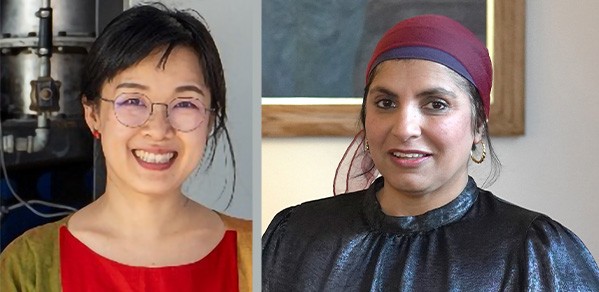
Research Associate Dr Curie Park and PhD student Dr Saleyha Ahsan have been recognised by the University with awards for their contributions to research impact and engagement.
Our community-driven approach empowered the locals to bring about change to the community. If villagers in the heart of the Himalayas can turn roadside waste into a cosy home, so can you, wherever you are.
Winner Dr Curie Park
The awards recognise outstanding achievement, innovation and creativity in devising and implementing ambitious engagement and impact plans, which have the potential to create significant economic, social and cultural impact from, and engagement with, research.
Collaboration Award winner 2025 – Dr Curie Park
A pioneering project to reduce and recycle plastic waste in Nepal has seen its leader Dr Curie Park, Research Associate Industrial Sustainability, win the Collaboration Award in the Cambridge Awards for Research Impact and Engagement.
Launched in 2022, Plastic to Ghar (P2G) is transforming Himalayan plastic waste into durable housing products. Led by the Centre for Industrial Sustainability at the Institute for Manufacturing (IfM), part of the Department of Engineering, the initiative engaged more than 70 local innovators, villagers and students through MAKEathons, prototyping, and three years of incubation, coaching and commercialisation.
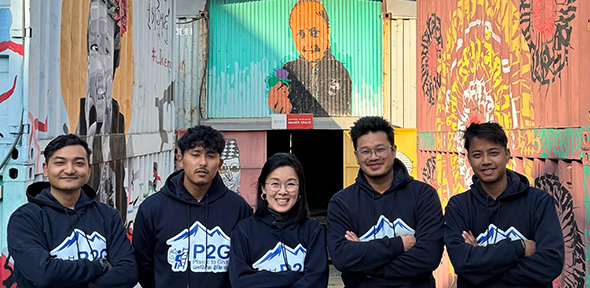
Dr Park (centre) with the P2G team in Nepal
The result is a localised circular economy ecosystem that includes three start-up’s and five plastic hubs across rural and urban areas, delivering lasting social and environmental impact. The project has led to job creation for isolated village communities, as well as technical and business training, improved living conditions, and reduced open burning and dumping of plastic waste.
Dr Park said: “Our community-driven approach empowered the locals to bring about change to the community. The P2G is a living proof of concept of localised circular economy in the most challenging environment. If villagers in the heart of the Himalayas can turn roadside waste into a cosy home, so can you, wherever you are.”
The next step will be the premiere and final showcase of the P2G documentary, on 19 March, at the Ray Dolby Auditorium, Cavendish Laboratory, as part of the 2026 Cambridge Festival. Booking is advised.
- Watch the story on the Himalayan villages at the P2G documentary premiere
- Engage in a panel discussion with Nepali start-ups and Professor Steve Evans, Director of Research in Industrial Sustainability at the IfM.
- Explore a showcase of Himalayan upcycled products.
- Take part in a one-off auction of furniture crafted with hope from the Himalayas.
Early Career Researcher Award – Highly Commended
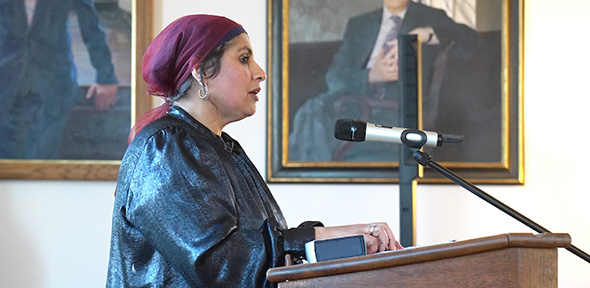
Dr Ahsan delivers a speech during the awards ceremony. Credit: Chris Loades/University of Cambridge
Dr Saleyha Ahsan, who is studying for a PhD in Engineering Health Systems Design, has been highly commended for a workshop that she ran as part of the Healthcare in Conflict Network (HCiC), funded by the West Hub Small Grants Programme.
The workshop encouraged collaborative analysis of the lack of global and interdisciplinary consensus on challenges to healthcare delivery in armed conflict.
The workshop built upon Dr Ahsan’s own work presented in a World Health Organization (WHO) and World Innovation Summit for Health (WISH) 2024 report titled In the Line of Fire – Protecting Health in Armed Conflict.
Attended by Ukrainian paramedics, clinicians, engineers, journalists, lawyers, non-governmental organisations (including MSF – Médecins Sans Frontières, the ICRC – International Committee of the Red Cross, MAP – Medical Aid for Palestinians) and academics, the workshop helped establish shared understanding across sectors and produced concrete data and steps toward future consensus development currently underway.
Dr Ahsan’s PhD is looking at the impact of attacks against healthcare in conflict from a health systems perspective. She has worked as a doctor, journalist and filmmaker in conflict areas including Syria.
Dr Ahsan said: “I am humbled and honoured to have received this commendation. It strengthens my conviction that the University of Cambridge can be a home from which many of the urgent challenges surrounding healthcare delivery in armed conflict can be addressed.
“I firmly believe Cambridge has a vital role to play through research, academic endeavour and practical engagement, in helping to navigate the complex and evolving threats facing health systems in an increasingly uncertain world.
“This work, conducted through a series of workshops, and drawing on Professor John Clarkson’s Engineering better care framework, sets out to establish the landscape of interdisciplinary challenges associated with delivering healthcare in armed conflict. The research findings will be presented through two CRASSH Healthcare in Conflict Research Network Starter Fund projects, the HCiC podcast and the HCiC Film Festival coming later this year.
“This work to date has only been possible through the collaborative support of many who remain actively involved as the research proceeds. In particular, I am deeply grateful to my supervisors, faculty advisers, tutors, mentors and my peers within the Department of Engineering, the International Health Systems Group, CRASSH, the Royal College of Emergency Medicine, my college Newnham, Emmanuel College, the Intellectual Forum and the West Hub. I remain deeply appreciative of the time, space and guidance I have been given to advance an engineering systems-thinking approach to this urgent and evolving global challenge.”
Adapted from a University of Cambridge article.
