
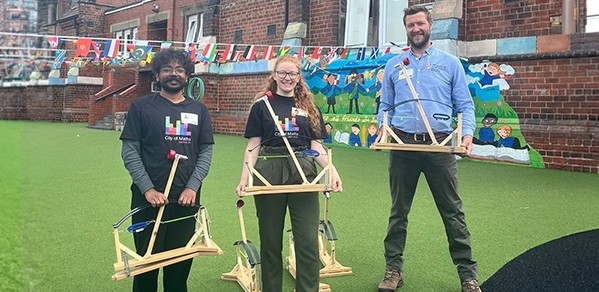
Hundreds of schoolchildren in Leeds were ‘bowled over’ to learn the connection between mathematics and cricket recently when they were invited to build working, small-scale replicas of the historic Venn cricket bowling machine as part of the UK’s first-ever City of Maths programme.
Our mini Venn cricket bowling machines were designed for the schoolchildren to build themselves, and in doing so, teach them that maths is not only about numbers and equations, but also about curiosity, creativity and solving real-world problems.
Thomas Glenday
Manufactured on-site at the Department of Engineering, University of Cambridge, by the Design and Technical Services team, the mini contraptions (accompanied by step-by-step build instructions) are based on a 7ft working replica which was brought back to life by the team in 2024.
The machine, originally designed by mathematician, logician and fellow of Gonville & Caius College Dr John Venn (1834 - 1923), delivered spinning cricket balls for batting practice, and in 1909, it famously bowled out players from the Australian cricket team during a visit to Cambridge.
As part of City of Maths – a new programme to celebrate mathematics and taking place across Leeds during 2026 and 2027 – schoolchildren have been constructing their own Venn cricket bowling machines to test different launch angles, and measure how these angles affect the distance travelled by the ball.
The hands-on workshops, held in mid-June, combined mathematics, engineering, teamwork and scientific investigation, helping pupils explore concepts such as measurement, forces and angles through practical activity. They also learnt more about the Venn diagrams used in classrooms, workplaces and research around the world.
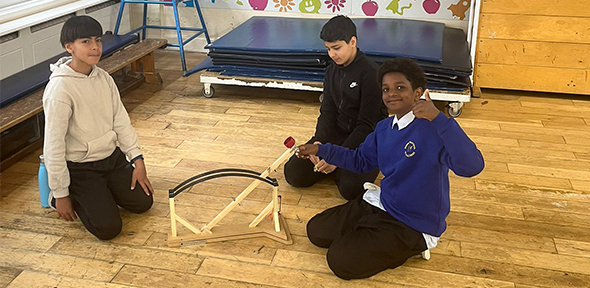
Pupils at Rosebank Primary School work together to build a mini Venn cricket bowling machine. Credit: Rosebank Primary School
The schoolchildren then had the opportunity to see the University of Cambridge’s full-scale replica of the machine for themselves, when it was put on show in Leeds city centre for a weekend. Visitors were invited to build and operate the mini versions of the machine and test their bowling skills by attempting to launch squash balls into buckets, while learning more about the mathematics and engineering behind the design.
Thomas Glenday, Head of Design and Technical Services at the Department of Engineering, University of Cambridge, said: “By bringing the Venn cricket bowling machine to Leeds as part of City of Maths, we have highlighted how mathematical thinking can lead to extraordinary inventions and discoveries. Our mini Venn cricket bowling machines were designed for the schoolchildren to build themselves, and in doing so, teach them that maths is not only about numbers and equations, but also about curiosity, creativity and solving real-world problems.”
Dr Ruth Holland, Head of Maths and Schools for City of Maths, said: “John Venn is known around the world for his famous diagrams, but his bowling machine reveals another side of his personality – inventive, playful and endlessly curious. These workshops and events gave people the chance to experience mathematics in a completely different way, combining history, sport, engineering and hands-on problem-solving. We were delighted to work with the University of Cambridge to bring this remarkable story to Leeds.”
Adapted from a City of Maths press release.
