
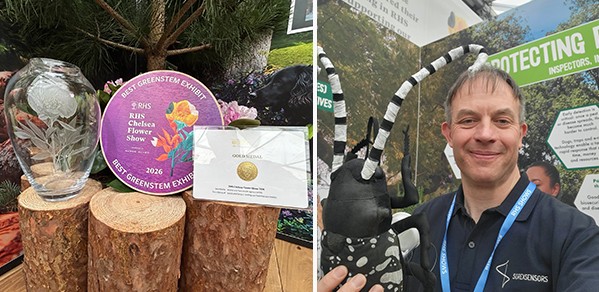
A breakthrough gas sensing technology developed from research in the University’s Electrical Engineering Division has received national recognition after winning a Gold Medal award at the 2026 RHS Chelsea Flower Show.
The Sorex Sentry sensing platform can be adapted to detect a wide range of chemical compounds, opening opportunities in sectors ranging from agriculture and food production to industrial safety and environmental monitoring.
Richard Parmee, Sorex Sensors CEO
The technology, commercialised by Cambridge spin-out Sorex Sensors, underpins the company’s newly launched Sorex Sentry platform – an ultra-sensitive ‘electronic nose’ capable of detecting target gases and chemical compounds at extremely low concentrations.
The device was part of a Gold Medal-winning stand in the Technology category at this year’s Chelsea Flower Show, providing high-profile recognition for a sensing platform with applications that extend far beyond horticulture.
Sorex Sensors, led by Professor Andrew Flewitt, Head of the Electrical Engineering Division, exhibited at the Chelsea Flower Show as part of an Animal and Plant Health Agency (APHA) showcase titled Scents and Sensors – Sniffing Out Plant Pests and Diseases, which highlighted innovative technologies designed to help protect the UK from invasive pests and plant diseases.
As part of the exhibit, Sorex Sensors demonstrated the Sentry platform using linalool, a naturally occurring compound associated with certain plant pests but also widely used in fragrances and perfumes. Despite operating in an environment filled with floral scents and thousands of visitors, the device successfully detected its target compound without generating false positives.
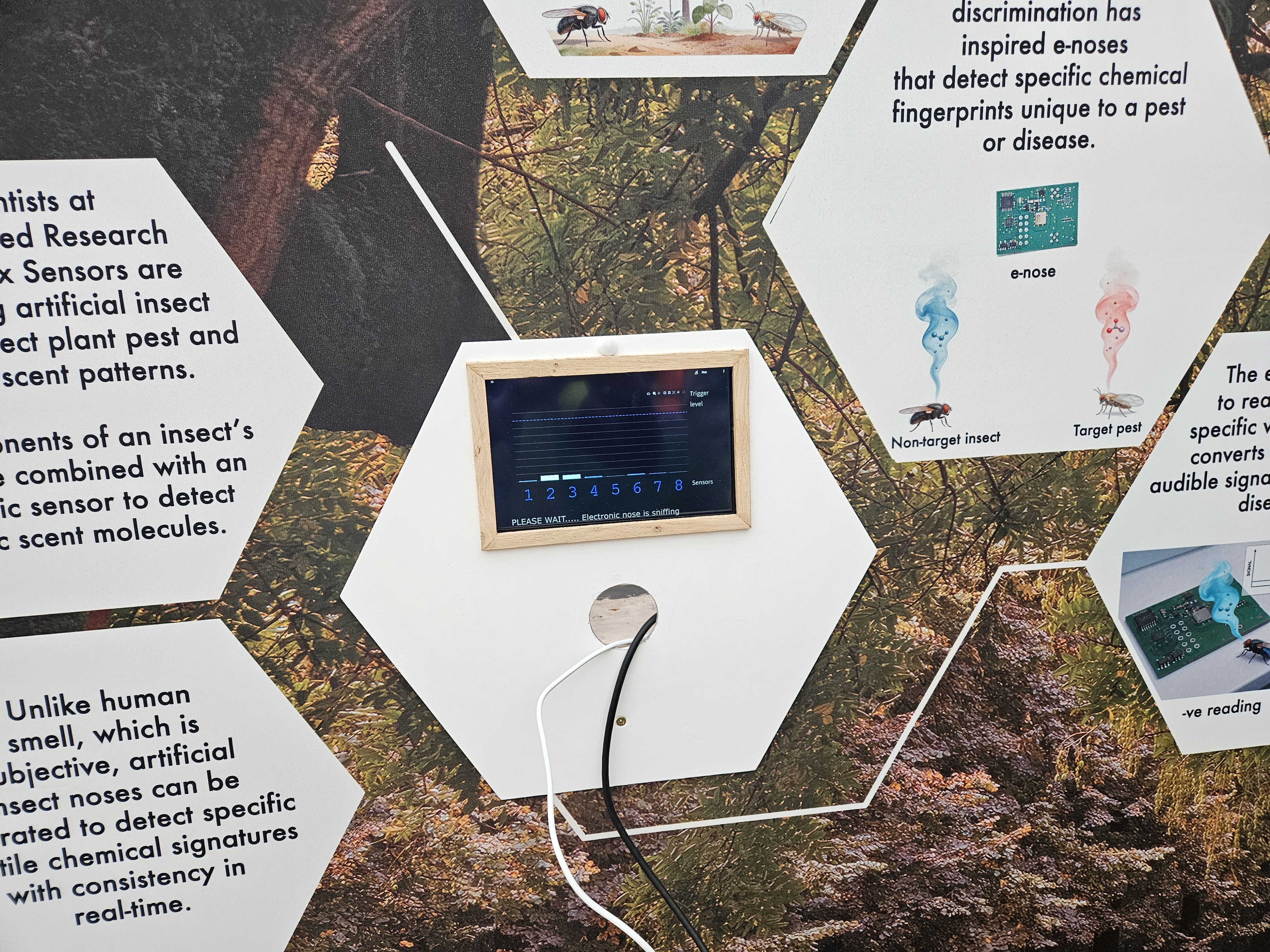
Sorex Sensors' 'electronic nose' on display at the Animal and Plant Health Agency (APHA) showcase at the RHS Chelsea Flower Show [click to enlarge].
Plant health inspectors routinely examine imported plants, produce and plant products entering the UK. Rapid identification of potential threats can play an important role in preventing the introduction and spread of harmful pests and diseases.
For APHA, the Sorex Sensors technology offers the possibility of providing rapid screening tools for inspectors dealing with large volumes of imported goods. By quickly identifying chemical signatures associated with particular pests or diseases, inspectors could target more detailed investigations where they are most needed.
Richard Lewis, Chief Executive of APHA, said: “Protecting the UK from invasive pests and plant diseases increasingly depends on our ability to harness emerging technologies. Innovations such as those being developed by Sorex Sensors have the potential to strengthen our surveillance and inspection capabilities by providing rapid, reliable detection tools that can support inspectors working at borders and throughout the supply chain.
“Collaboration between researchers, industry and government will be essential if we are to meet future biosecurity challenges and protect the nation’s plants, crops and natural environment.”
From Cambridge lab to commercial product
Sorex Sentry has been designed as a flexible sensing platform that can be tailored to different applications by changing the sensor configuration. Rather than creating separate devices for individual markets, Sorex Sensors has developed a universal platform capable of supporting multiple sensing tasks.
“The Sorex Sentry provides a straightforward ‘yes/no’ output to tell users if a target gas is present in tiny concentrations in an environment,” said Professor Flewitt.
Potential future applications include monitoring indoor air quality, detecting toxic industrial gases, identifying contamination in food supply chains, supporting transport safety systems and enabling portable environmental monitoring devices. The company is also exploring wearable gas detection systems for emergency responders and smaller, lower-cost consumer products.
Richard Parmee, Chief Executive Officer of Sorex Sensors, added: “The Chelsea Flower Show provided an excellent opportunity to demonstrate that this technology works in challenging real-world environments. What makes Sorex Sentry particularly exciting is its flexibility. The same core sensing platform can be adapted to detect a wide range of chemical compounds, opening opportunities in sectors ranging from agriculture and food production to industrial safety and environmental monitoring.
“The award is a welcome recognition of the progress the team has made in translating world-class Cambridge research into a practical commercial technology that can deliver real benefits for industry and society.”
Adapted from a news article first published on the Electrical Engineering at Cambridge website – written by Michael Shuff.
