
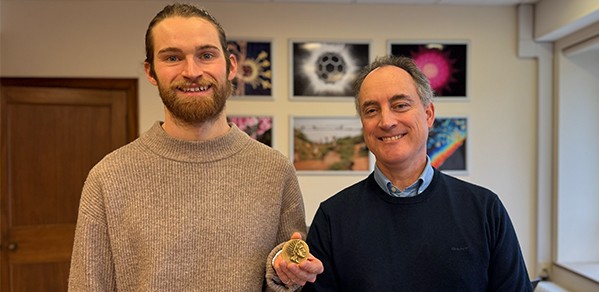
PhD student Jack Peden has been announced as the winner of the Department’s 2025 Helios Prize – awarded for research on sustainable energy and/or energy efficiency.
Winning the Helios Prize is a great honour. It is wonderful to see our work recognised as being impactful in the field of clean energy and energy efficiency.
PhD student Jack Peden
The Helios Prize was launched in 2019 and is made possible thanks to a generous donation from Cambridge alumnus John Firth. John approached the Department specifically and asked that the prize be named after the Greek sun god Helios, because the world’s renewable energy is fundamentally driven by solar energy.
Jack, a Harding Distinguished Postgraduate Scholar, won the Prize for his co-authored research paper titled Production of hydrogen and carbon nanotubes from methane using a multi-pass floating catalyst chemical vapour deposition reactor with process gas recycling.
Published in the journal Nature Energy, the paper details the results of a technology that has the potential to be scaled up for real-world use, providing an opportunity to produce sustainable fuel and materials from a single process.
A research team from the University of Cambridge and Stanford University modified a continuous-flow reactor and successfully converted methane (natural gas) into hydrogen with low CO2 emissions alongside high-performance carbon nanotube (CNT) materials. These CNTs can act as sustainable replacements for CO2-intensive materials such as steel, aluminium and copper.
This process could be a key enabling step for methane pyrolysis, by which methane is converted into turquoise hydrogen, resulting in solid carbon, therefore avoiding the creation of CO2.
The carbon nanomaterials produced by this process have already shown promise in batteries and textiles, and could in future be used in lightweight composites, building materials or high-voltage electrical cables.
“Winning the Helios Prize is a great honour,” said Jack. “It is wonderful to see our work recognised as being impactful in the field of clean energy and energy efficiency.”
Currently in the third year of his PhD, Jack is focused on understanding the behaviour of catalyst particles and CNTs as they nucleate and grow inside the reactor. He will study this using in-situ laser diagnostics, particularly laser-induced incandescence.
“I have developed an optically transparent reactor that allows us to take optical measurements directly inside the reaction zone – something we have not achieved before,” said Jack. “I am in the process of integrating the reactor with the laser system and hope to begin commissioning the optical system this spring.”
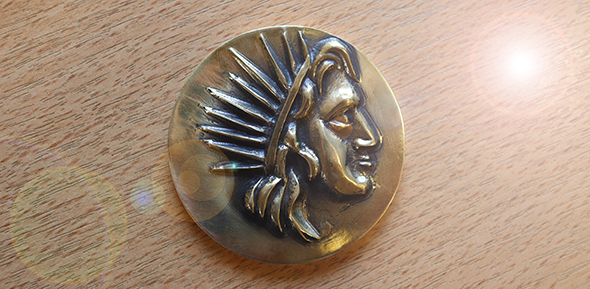
Jack (Darwin College) was presented with prize money, along with a brass medal depicting the face of Helios. The medal was crafted by Alistair Ross, former Manager of Design and Technical Services at the Department of Engineering. He machined it on-site using a 3D pantograph and drew inspiration for the design from a Helios coin loaned to him by the Fitzwilliam Museum, believed to date from the 2nd to 1st century BC.
“The medal itself is beautiful; I will keep it on display as a reminder of this achievement,” added Jack.
