

Cambridge engineers are preparing themselves for work in a global environment with language lessons designed for their technical and cultural needs.
As well as learning how to communicate in another language, it brings a greater awareness of culture and diversity.
Professor David Tual
The Centre for Languages and Intercommunication (CLIC), at the Department of Engineering, offers language lessons in Chinese, French, German, Japanese and Spanish, as well as English. The lessons are specifically geared towards future engineers.
Professor David Tual, director of CLIC, said engineers who also studied languages were preparing themselves to have global impact, whether working at home or abroad.
“As well as learning how to communicate in another language, it brings a greater awareness of culture and diversity. This greater understanding is of benefit to students wherever they work.”
The lessons are free for staff and students at the department but are also available for a fee to other members of the university.
He said CLIC trained students and staff to communicate effectively across diverse teams in increasingly broad and complex environments. Learners also had the opportunity to visit other countries for intensive language tuition and cultural education, as well as visiting other engineering institutions.
Japanese learners recently visited Tokyo and the historic city of Kanazawa to learn more about the country’s language, culture and engineering.
David said: “This trip was a great opportunity to strengthen our links with Japan. We were hosted by the University of Tokyo, but we also delivered a workshop at the Tokyo University of Agriculture and Technology and set up a telecollaborative project with the Institute of Science Tokyo."
Undergraduate engineer and language learner Nina Rahimi took part in the Japanese trip and said: "It was a really valuable learning experience, thanks to the intensive Japanese lessons. It was also a great opportunity to meet and talk with students and academics.
“This was especially important to me as it has long been a goal of mine to live and work in Japan as an engineer in the future. Our week at the University of Tokyo encouraged me to think about pursuing further study there.”
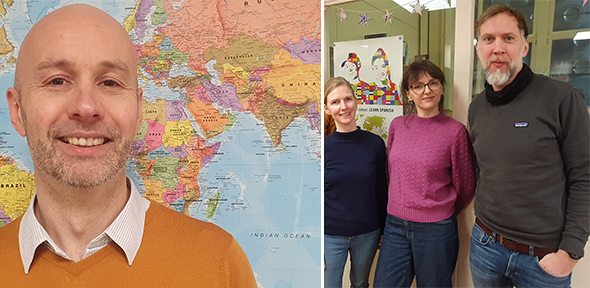
David Tual and CLIC team members Kim De Silva, Katarzyna Lanucha and Jan-Moritz Bogdanovic
CLIC has set up a worldwide network of institutions, Global Engineers Languages and Skills (GELS), to provide a clear and confident focus on the specific communication needs of engineers. All the institutions visited on the trip are part of this growing network, which was set up by CLIC in 2015 and now has more than 60 member institutions around the world including in Malaysia, Ukraine and the US.
In addition to language courses and academic, cultural or career support, CLIC also offers a range of workshops on communication skills including emotional intelligence, diversity and inclusion, collaboration skills and professional presence.
For 2026 these include:
• “Everybody speaks English, right?” which will highlight the challenges of a universal language of communication, accent bias and nuance.
• “The Melting Pot Mystery: Navigating International Cambridge” which will explore cultural preferences for working and develop cultural intelligence.
• “Overcoming self-doubt: Tackling imposter syndrome” which will support students by developing actionable strategies to overcome self-doubt.
David said: "We aim to prepare students and researchers to successfully navigate a range of academic, professional and social settings in different languages and cultures."
