
Making augmented reality (AR) glasses smaller, lighter and more power-efficient is a key challenge in bringing the technology closer to everyday consumer use. Cambridge photonics expert Professor Daping Chu is part of an international team helping to address that challenge through optical innovation and industrial collaboration.
This new production line is an important milestone in taking optical innovation into large-scale manufacture.
Professor Daping Chu
A manufacturing facility in Wuxi, China, operated by Optiark, a company co-founded by Professor Chu from the University of Cambridge’s Department of Engineering, is designed to produce up to one million optical waveguide modules a year at full capacity. These modules are key components of AR display systems, guiding light from a miniature optical engine through transparent waveguides and towards the wearer’s eyes.
The production line, which opened in September 2026 in Liangxi District, represents a significant step towards the large-scale manufacture of the optical systems needed for the next generation of AR glasses.
One of the major challenges facing AR glasses is how to combine sophisticated optical displays with the small size, low weight, low power consumption and affordability needed for everyday use.
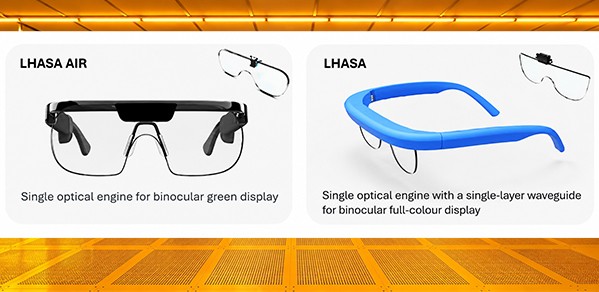
Optiark’s approach addresses one part of this challenge by using a single miniature optical engine to serve both eyes. Rather than requiring a separate optical engine for each eye, the company’s binocular waveguide design directs image light from one engine through an integrated optical system to both eyes.
Reducing the number of optical engines can lower component count, power consumption and weight, while also simplifying the optical alignment required during assembly. In principle, this can make AR display systems smaller, simpler and less expensive to manufacture.
The new Wuxi facility is intended to take this type of optical technology from specialist production towards the scale required for a growing consumer market. The RMB 300 million project uses 12-inch manufacturing technology and includes nearly 5,000 square metres of cleanroom space, with areas reaching Class 100 cleanliness.
Professor Chu said: “This new production line is an important milestone in taking optical innovation into large-scale manufacture. Making AR glasses practical for everyday use requires compact optics that can be produced reliably and affordably. It is rewarding to see the ideas developed by our international team reaching commercial products, and this facility gives us the capacity to support their wider adoption.”
From optical research to consumer AR

Production equipment at Optiark’s new Wuxi facility. Source: Wuxi Broadcasting Liangxi Media Centre via Sina Finance
Waveguides guide light through a thin, transparent lens and direct it towards the eyes, allowing digital images to be seen alongside the user’s surroundings. They are therefore a key component in making AR glasses sufficiently compact and lightweight for everyday use.
Optiark was founded in 2020 by AR optics specialist and CEO Yisheng Zhu, diffractive waveguide pioneer Tapani Levola, and Professor Daping Chu. Professor Chu holds the Nanjing Chair of Technology and Innovation and directs the Cambridge Centre for Photonic Devices and Sensors (CPDS), where his research includes photonic devices and AR/virtual reality (VR) displays.
The company’s patent portfolio includes Chinese patent CN113687512B, granted in February 2024. The inventors are Optiark’s CTO Dr Houqiang Jiang, Professor Daping Chu, Jiayu Deng and Yisheng Zhu.
The patent describes binocular AR waveguide arrangements, including a single-engine configuration that directs image light to both eyes while making use of otherwise lost light to improve display brightness.
The approach has subsequently been incorporated into a number of AR glasses and display products. An interview with Dr Jiang published by VR Tuoluo identifies applications including Rokid Glasses, Meta Lens S1 and S3, Xuanjing M5 clip-on AR glasses, and Leion Hey2.
These applications illustrate the potential of optical engineering to address some of the practical barriers to making AR displays smaller, lighter and more accessible.
Connecting Cambridge research with industrial innovation
Professor Chu’s involvement in Optiark reflects the growing role of collaboration between academic research and industry in moving advanced photonics technologies towards commercial application.
At Cambridge, the CPDS conducts research spanning photonic materials, optical devices, displays, sensing technologies and related applications, supporting developments across healthcare, communications, manufacturing and consumer technologies.
The opening of Optiark’s new production facility provides a route for technologies developed through this international research and industrial collaboration to be manufactured at substantially greater scale – potentially helping to accelerate the development of AR glasses that are practical for everyday use.
This article first appeared on the Electrical Engineering at Cambridge website – written by Michael Shuff.
