
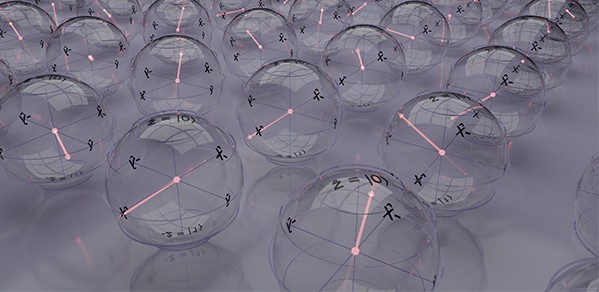
Two research projects which draw on expertise from the Department of Engineering are among the inaugural first funding call announced by the IonQ Quantum Innovation Centre at Cambridge.
By bringing quantum computing, networking, sensing and security research together at Cambridge, we are accelerating the timeline between academic discovery and commercial quantum advantage.
Niccolo de Masi, Chairman and CEO of IonQ
The opening of the Centre which occurred in October 2026 marks the next phase of the University’s corporate research partnership with quantum technology company IonQ and strengthens Cambridge and the UK’s position at the forefront of quantum research.
The 10-year strategic partnership aims to accelerate research and discovery across quantum science, engineering and related applications in the UK.
The Centre provides significant funding for investigator-led blue-skies and translational research across quantum technologies and will host a state-of-the-art 256-qubit IonQ quantum computer, due to be deployed at the University of Cambridge by summer 2027.
Computational structural engineer Professor Fehmi Cirak and optical engineer Dr Amit Agrawal have seen their projects selected by a joint steering committee comprising business and scientific leaders from the University and IonQ.
Across both projects, students and postdoctoral researchers will gain experience connecting fundamental research with technology development and applications, helping train the next generation of leaders in quantum science and engineering.
The projects will combine Cambridge’s research expertise with IonQ’s capabilities in trapped-ion quantum computing, quantum networking and device engineering and are detailed as follows:
Beyond the curse of dimensionality in engineering dynamics
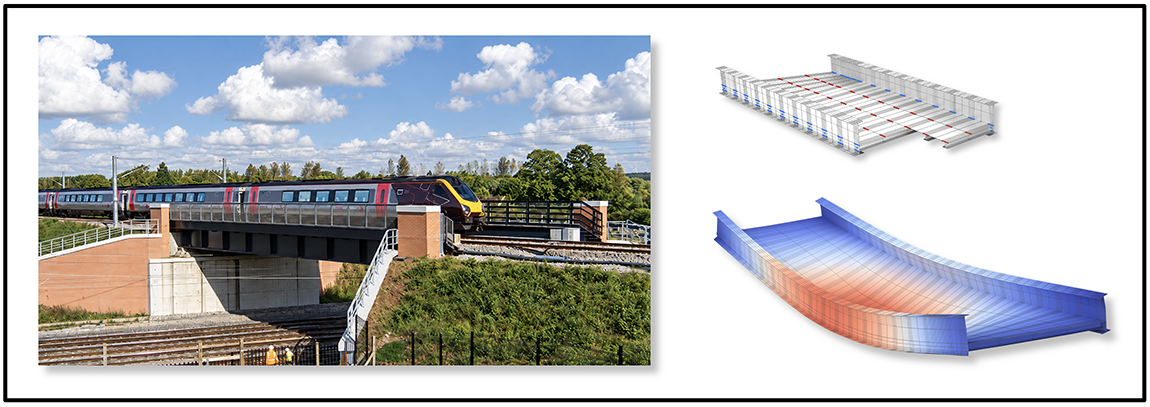
Source: Digital twinning of self-sensing structures using the statistical finite element method. Febrianto, E and Butler, L and Girolami, M and Cirak, F. Data-Centric Engineering, 3, 2022 [click to enlarge].
Professor Cirak will lead a research project exploring whether quantum algorithms can directly compute the probability distributions describing how engineering structures, such as bridges, wind turbines and aircraft, respond to uncertain loading from earthquakes, strong winds and mechanical vibrations. The aim is to predict structural behaviour and likelihood of failure, especially under extreme conditions.
Currently, estimating these probabilities can require the simulation of thousands or millions of individual scenarios, making the calculations prohibitively expensive. The difficulty escalates further with every additional source of uncertainty, an effect known as the ‘curse of dimensionality’.
“Now we are exploring a different approach,” said Professor Cirak. “Using new methods designed for quantum computers, we hope to make these calculations substantially faster, eventually allowing us to solve engineering problems that are currently beyond the reach of classical computers. We will test these methods on IonQ systems.”
He added: “We would like to show that our computational methods can accurately predict the response statistics of engineering structures, even on today’s noisy quantum computers.
“This project builds on our quantum computational mechanics research, which we began about three years ago and have since expanded to include two PhD students and a postdoctoral researcher. This funding from the IonQ Quantum Innovation Centre will help us continue this work by providing access to quantum computers and supporting our research team.
“I am excited about the opportunities the Centre is creating for us to collaborate with colleagues in engineering, the sciences and mathematics across Cambridge. I believe that this kind of interdisciplinary environment is essential for helping young researchers find their own directions in quantum science and engineering.”
Meta-mirror cavity arrays for trapped-ion cavity QED
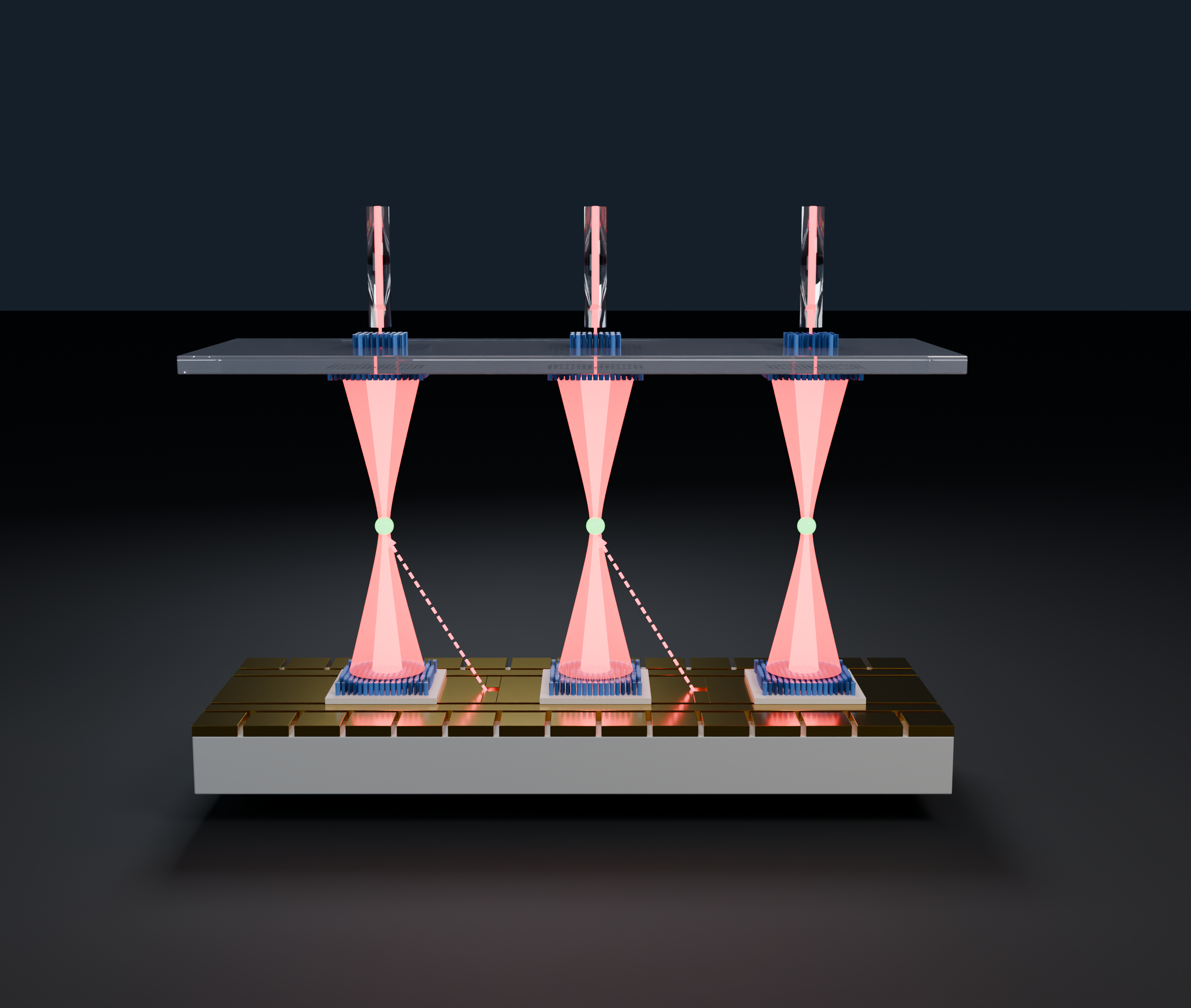
A schematic of the proposed chip-scale interface that uses nanostructured mirrors to efficiently collect light from individual trapped ions and direct it into optical fibres. Credit: A. Agrawal and P. Cloud
Dr Agrawal will lead a research project developing flat mirrors – patterned at the nanoscale – that act like curved mirrors for use in trapped-ion quantum computers[1]. Trapped-ion quantum computers store information in individual ions (charged atoms) and read it out by collecting the light that the ions emit.
Dr Agrawal and his team will use pairs of these flat mirrors to form miniature optical cavities that capture more of the light from the ions and send it into an optical fibre. Optical fibres carry that light between quantum processors, where it is used to link ions in separate machines, so that they work as one larger computer.
“Each link needs light from both machines, so doubling the light collected makes linking four times faster,” said Dr Agrawal. “And because our flat mirrors are made with chip-manufacturing techniques, they can be built as arrays with one cavity per ion, supporting more efficient readout and the linking of quantum computers into networks.”
He added: “Today, the light is usually collected with a lens which catches only a small fraction of what the ion emits. A cavity does better but cavity mirrors are normally curved and shaped one at a time. Our mirrors are flat with the curvature written into a nanoscale pattern, so many identical cavities can be made at once and lined up with a standard fibre array.
“In the ideal case, our flat mirror design captures about 60% to 80% of the ion’s light into the cavity. This compares with about 20% for a high-end lens and a few per cent for light-collecting optics built directly into the trap chip.”
The partnership has the potential to see Dr Agrawal and his team work with IonQ on its trap-chip requirements. This would mean that the miniature optical cavities formed by the research team’s flat mirrors could be designed to fit real hardware from the start.
“A successful outcome for us would be to have mirrors that reflect at least 99.5% of the light and a working row of cavities on a chip, several of them coupled into optical fibres,” he said. “We would also have a design that IonQ could potentially use to build these cavities into its trap chips.”
The students on this project will design and test hardware to the needs of a commercial quantum computing company, resulting in valuable experience for building a career in quantum engineering.
Nine research projects have been awarded in total through the Centre’s first funding call, spanning a broad range of disciplines and potential applications in quantum computing, networking, sensing and security.
Professor Mete Atatüre, Head of the Cavendish Laboratory, Department of Physics, where the Centre is based, said: “The official launch of the IonQ Quantum Innovation Centre is an exciting milestone in our partnership with IonQ, which will help Cambridge and the UK stay at the forefront of the quantum revolution. The announcement of the first round of the funded research projects celebrates the depth and breadth of expertise and talent at Cambridge and will accelerate our impact in quantum science and engineering.”
Niccolo de Masi, Chairman and CEO of IonQ, said: “The opening of the IonQ Quantum Innovation Centre turns a landmark agreement into a working home for quantum research inside one of the world’s most storied physics laboratories. By bringing quantum computing, networking, sensing and security research together at Cambridge, we are accelerating the timeline between academic discovery and commercial quantum advantage. This is a long-term commitment to the United Kingdom, built for researchers, start-ups and industry alike.”
Adapted from a Cavendish Laboratory, Department of Physics news article.
- - -
[1] Trapped-ion quantum computers suspend individual ions in a vacuum using electric fields and use lasers to control their electronic energy states as qubits (quantum bits). Every ion of an element is identical and holds its quantum state for a long time, which gives some of the most accurate operations of any quantum computing platform.
