
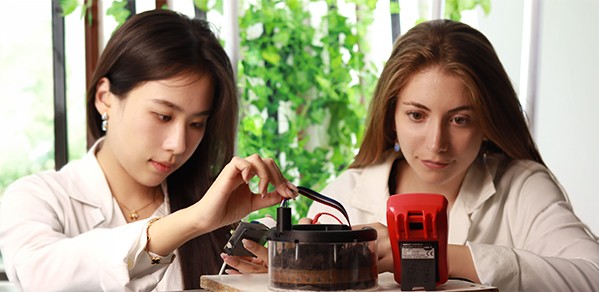
Researchers in the Bio-Inspired Robotics Laboratory at Cambridge are exploring how soil behaves as an intelligent system. By studying its structure, chemistry and biological network of microbes and fungi, they aim to inspire new technologies in bio-inspired computing, precision agriculture and environmental sensing.
Soil has inherently rich, nonlinear and dynamic electrical properties. This means soil could act not only as a sensing medium but also as a form of natural analogue processor, inspiring advancements in bio-inspired computing, environmental monitoring and precision agriculture.
PhD student Catherine Merchant
Recognising soil as an active, embodied information processor – constantly sensing, filtering and transforming flows of matter (e.g. rainwater) and energy (e.g. sunlight) into plant growth and nutrients, for example – reframes soil not as “just dirt”, but as a living system that senses, remembers and adapts. Viewed in this way, soil is challenging the traditional view that intelligence requires a brain.
Inspired by Electrical Impedance Tomography (EIT) – a real-time imaging and monitoring technology that measures the electrical conductivity and impedance of materials – PhD students Catherine Merchant and Xiaoxian (Amanda) Xu from the Bio-Inspired Robotics Laboratory set about adopting this technique to observe the inner workings of soil.
Catherine explains: “In this context, soil is particularly interesting as a computational medium because of its inherently rich, nonlinear and dynamic electrical properties. These properties allow soil to respond to external stimuli (such as electrical signals, moisture variation or biological activity) in ways that can encode and process information. This means soil could act not only as a sensing medium but also as a form of natural analogue processor, enabling low-energy, distributed computation directly within the environment.
“Such an approach could open up new possibilities for adaptive sensing, environmental monitoring and precision agriculture, where computation is embedded directly in the physical system being observed.”
Using EIT to identify different soil types
Their first published work, co-authored by Professor Fumiya Iida, used EIT to classify soil types and categorise them based on grain size. With this approach, they were able to develop what they believe is the first non-vision-based sensor system capable of classifying soil type and moisture level.
The researchers say that identifying the soil type is important because different soils have various physical and chemical properties, affecting water retention, nutrient availability, drainage, and ultimately crop productivity.
Moisture levels are measured because the electrical properties of soil change significantly where moisture is present. This way, any differences detected by EIT can then be determined as being connected to the soil type itself or to variations in water content. Their findings were reported at the 2025 IEEE/RSJ International Conference on Intelligent Robots and Systems (IROS).
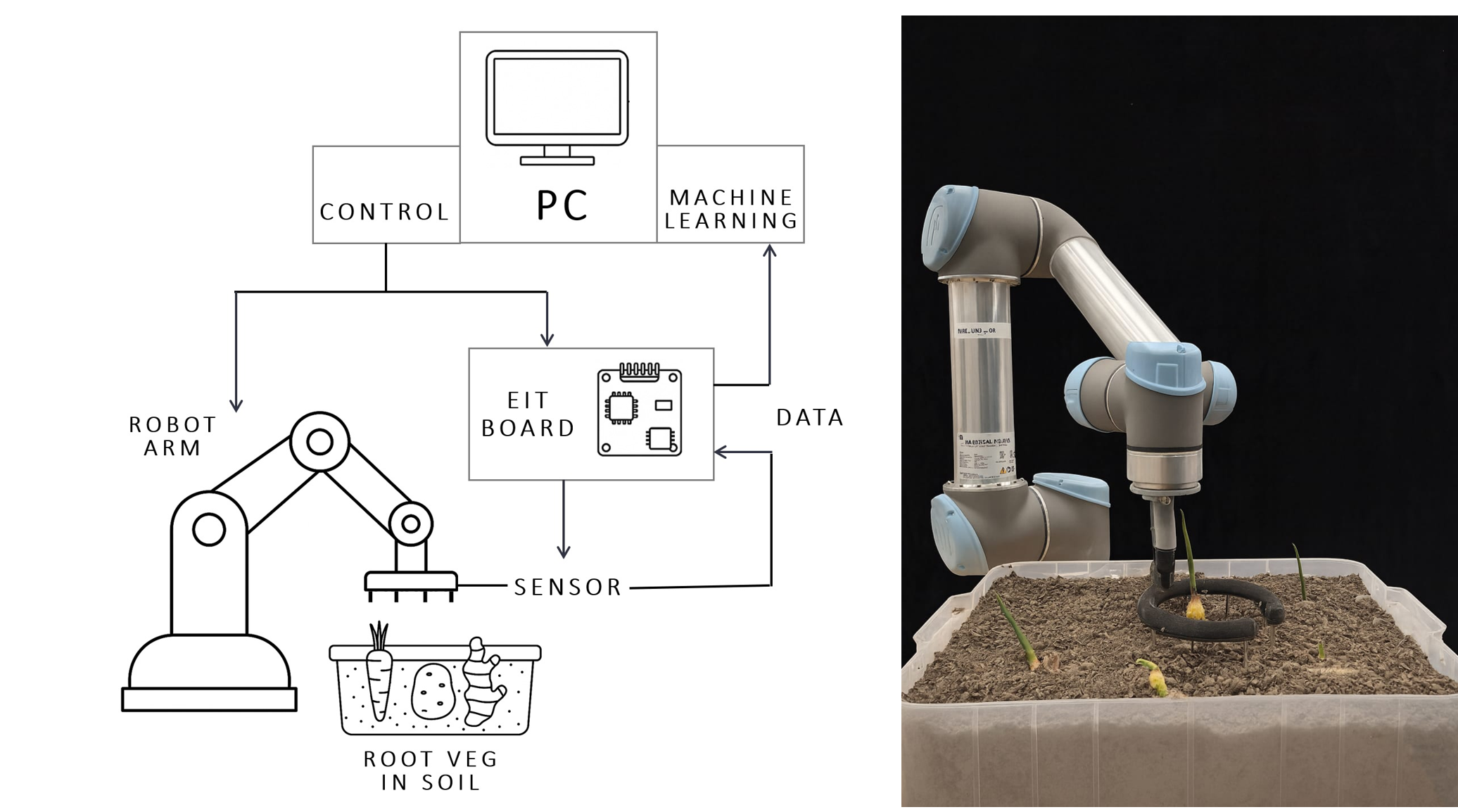
Overview of the experimental set-up, showing the integration of a robotic arm, EIT board, and a PC for control and analysis of vegetables in soil
Soil as a physical computer, farmer's 'smart' companion and environmental early warning system
Following this research, a recent perspective article has been published in the IOP Conference Series: Materials Science and Engineering, in which Catherine and Amanda argue that soil has a responsive intelligence, and can be viewed as a form of embodied computation in its own right, thus inspiring advancements in:
Bio-inspired computing – encouraging the design of algorithms and soft robots that use the material properties of their own bodies, their flexibility, shape etc., to interact with the environment, rather than relying on a heavy computer processor or complex programming. This is like the information processing role of soil’s physical body: its grain and pore architecture and its dependent properties (e.g. moisture and carbon storage) are continually evolving across different landscapes and over time.
Precision agriculture – contemporary ‘smart’ farming technologies such as advanced sensors, Internet of Things (IoT) systems and robotics are examples of precision agriculture in action: enabling the real-time monitoring of soil moisture, pH and nutrient dynamics, allowing farmers to make informed decisions that are responsive to the specific needs of the soil. In this way, soil can be viewed as the “active intelligence partner in farming”, say the researchers, becoming “both co-processor and collaborator, enabling a form of agriculture where technology and ecology are integrated into a single system of care”.
Environmental sensing – by treating soil as an embodied sensor, one that is continuously registering environmental change, it can be used in sensing technologies to measure variables like moisture and temperature, acting as an early warning system before surface indicators appear. This is where EIT is most effective, say the researchers, in revealing soil’s hidden dynamics by using imaging to make soil’s internal state ‘visible’, and flagging drought, contamination or decline in soil health in good time.
This work was supported by the Engineering and Physical Sciences Research Council (EPSRC) and the EPSRC Centre for Doctoral Training (CDT) in Agri-Food Robotics – AgriFoRwArdS CDT [EP/S023917/1]. The authors would also like to acknowledge the generous support of the James Dyson Foundation.
References:
X. Xu, C. Merchant, M. Ishida, D. Hardman and F. Iida. ‘In-Situ Classification of Soil Types Exploiting Electrical Impedance Tomography with a Robotic Actuating Probe’. 2025 IEEE/RSJ International Conference on Intelligent Robots and Systems (IROS) (2025). DOI: 10.1109/IROS60139.2025.11246829.
Catherine Merchant et al. ‘Embodied Intelligence of Soil’. IOP Conference Series: Materials Science and Engineering (2026). DOI: 10.1088/1757-899X/1343/1/012026
