
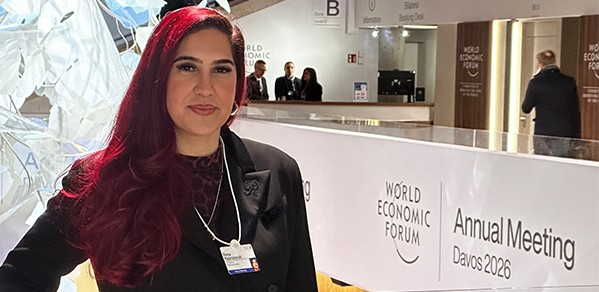
Rana Hajirasouli's company, The Surpluss, was one of five global start-ups to address the World Economic Forum (WEF) 2026 on AI in circular value chains, intelligent infrastructure and resource security.
The core engineering challenge here is not building software; it is designing robust resource coordination systems under real constraints.
Rana Hajirasouli
Researcher Rana Hajirasouli, founder and CEO, is aiming to save billions of tonnes of waste materials from businesses around the world. She set up The Surpluss to enable a structured transition to a circular economy through an AI platform. The company, based in the United Arab Emirates, aims to reduce waste and enhance resource security by shortening vulnerable supply chains.
By combining her knowledge of international relations and industrial systems, The Surpluss has achieved 300% growth in the last year. Rana's work has also been recognised by global leaders. She was invited to speak about AI in circular value chains, intelligent infrastructure and supply chain/resource security at the WEF 2026 in Davos. The Surpluss was one of only five global start-ups to be invited by UpLink, the WEF's early stage innovation engine.
Rana, a doctoral researcher at the Department of Engineering’s Institute for Manufacturing, is helping businesses become more resilient while also supporting UN Sustainable Development goals.
She explained: “The core engineering challenge here is not building software; it is designing robust resource coordination systems under real constraints. These can include incomplete information, regulatory friction, logistics, emissions accounting and behavioural inertia.
“In today’s geopolitical context, with supply chain fragmentation, localisation pressures and strategic resource risk, the ability to map and reconfigure existing resources is increasingly a matter of economic and industrial resilience. Engineering expertise is essential to make our systems function reliably and at scale.”
She added: "Around 100 billion tonnes of materials are produced each year but 92% of those are lost from the supply chain. The Surpluss aims to support their redistribution by reusing this waste to create supply chain stability, new products and industrial symbiosis.
“This is a $1.6 trillion a year issue and the problem is growing each year!”
So far, The Surpluss has helped save more than 4 million kgs of resources from going to landfill.
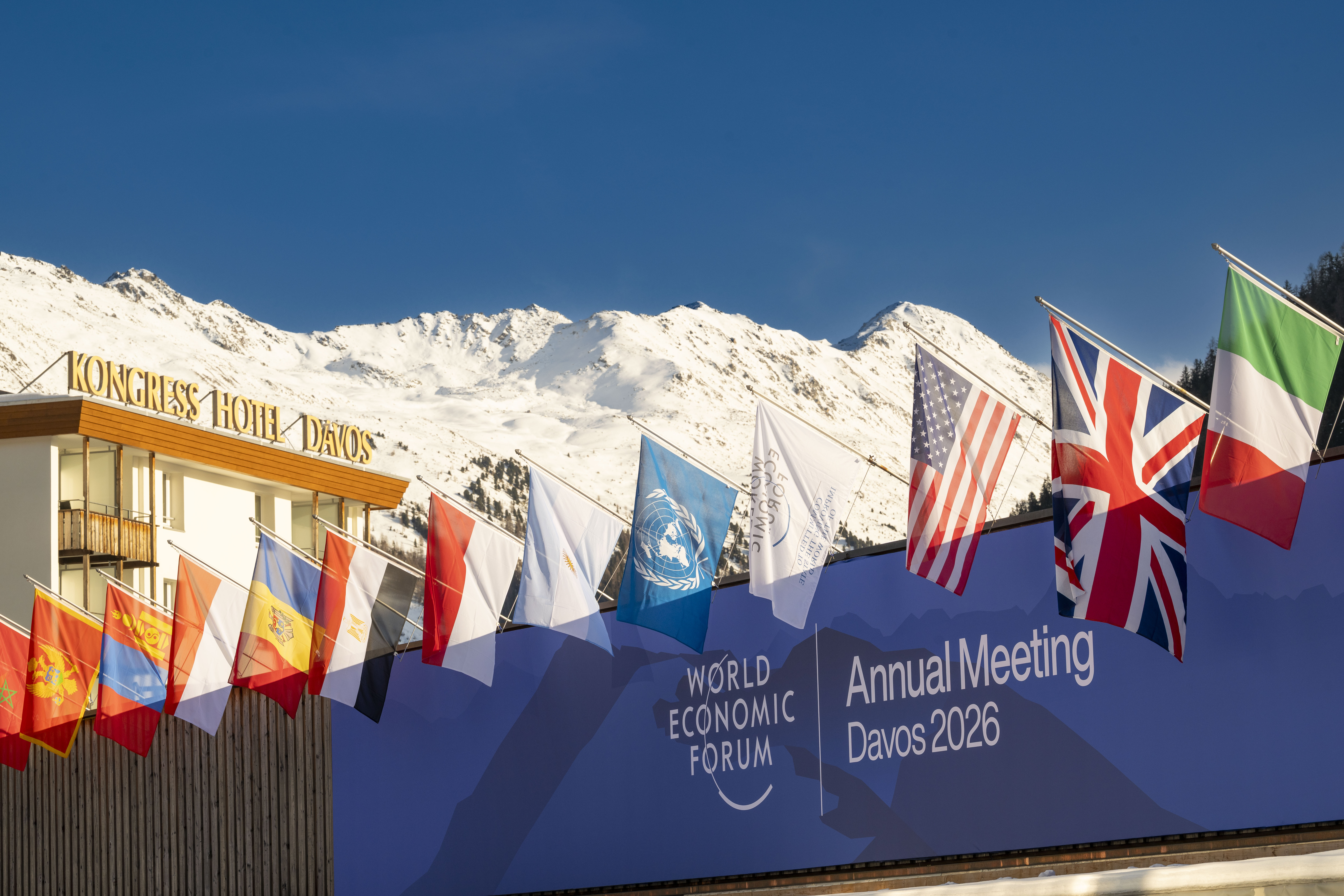
World Economic Forum 2026 Credit: Thibaut Bouvier
Rana said that by moving away from a linear and purely environmental view of recycling, The Surpluss was helping businesses save money, as well as reducing carbon emissions. The default model for growth of take, make and dispose of created deep vulnerabilities, exposing companies to supply shortages and volatile pricing. A circular model, based on reusing, repairing and sharing resources in real time, acted as a risk buffer, insulating businesses from shocks. It also identified new value streams and allowed faster sourcing, with the additional benefits of lower prices and carbon emissions.
The platform uses AI to interpret messy, unstructured organisational data and human input. It is then turned it into something legible, searchable, and actionable at scale. This provides a means of security by identifying the location of assets and materials. It also gives businesses information to find secondary market opportunities and pricing mechanisms.
“Circularity isn’t just about doing less harm; it’s about creating smarter industrial systems that endure change.”
And Rana takes a broad view of waste.
“Waste can be space and knowledge, as well as materials. It can be underused resources. Our mission is to build the universal digital infrastructure that makes secondary resources instantly discoverable and traceable across global markets. Every wasted resource or by-product is more than an environmental issue; it’s lost value. Businesses that fail to close their loops often find themselves spending more on raw inputs, disposal and compliance, all while missing out on potential secondary markets.”
She explained: “Our system is digital, but the outcomes are very physical: materials move, assets are redeployed, supply chains are shortened.”
The business operates via a monthly subscription or through partnerships. Organisations pay for access to the coordination infrastructure of resource intelligence, traceability, matching logic and reporting.
“We deliberately do not monetise individual donations or transactions, because the value lies in system efficiency, not volume."
The platform uses AI to interpret messy, unstructured organisational data and human input. It is then turned it into something legible, searchable, and actionable at scale. This provides a means of security by identifying the location of their assets and materials. It also gives businesses information to find secondary market opportunities and pricing mechanisms.
“In today's world, with lower barriers to technology and oversaturation of products, we wanted to ensure customers get a return on investment as fast as possible. This enables us to gather more primary data and triangulate it with open source intelligence for the best possible outcomes for circular network formation.
"At The Surpluss, we work with institutions, governments, and businesses to make secondary resources economically legible. The same unit of matter can remain physically unchanged while holding radically different economic futures, depending on whether it is classified as waste, stock, surplus, scrap, liability, donation, or reusable input. These inefficiencies only become actionable when resources occupy a reachable classificatory state: visible enough to be identified, structured enough to be valued, and translatable enough to move across departments, firms, sectors, or regions. In that sense, our technology solves an ontology problem before it solves a transaction problem. Companies cannot price what they cannot see, and they cannot coordinate what they cannot classify. As workflows become increasingly digital, physical resources are lagging behind, trapped in accounting categories that no longer reflect their material condition, redeployment potential, or strategic value."
Rana’s PhD investigates the pre-network conditions of industrial symbiosis 4.0, focusing on how information asymmetry influences resource security and economic coordination between firms. What began as a sustainability goal is now a competitive differentiator for The Surpluss, by enhancing supply chain visibility, industrial resilience and turning underutilised resources into strategic economic intelligence.
What began as a sustainability goal is now a competitive differentiator for The Surpluss, by lowering costs, protecting brand reputation and signalling a long-term responsibility to investors and customers.
- The Surpluss was one of the first start-ups to be part of King's College's new incubator programme, SPARK. Created by King’s E-Lab, in partnership with Founders at the University of Cambridge, SPARK acts as an entrepreneurial launchpad. It aims to turn research-backed ideas from University of Cambridge students and alumni into investable companies.
