
From quantum computing to AI infrastructure and autonomous systems, much of today’s deep tech innovation depends on how well we can control and manipulate light. While software and systems have advanced rapidly, the underlying optical hardware hasn’t kept pace. In fact, one of the biggest constraints facing these technologies is something far less visible: the way optics are still made.
Our metasurfaces mean that advanced optics can be manufactured using the same large-scale semiconductor foundry processes used to produce microchips, rather than being assembled piece by piece.
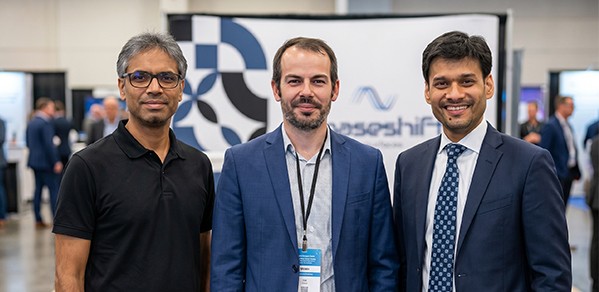
Dr Amit Agrawal
That’s what Cambridge Enterprise Ventures' portfolio company Phaseshift has set out to change by leveraging pioneering research in optic materials and their assembly from the University of Cambridge.
Co-founder and CTO, Dr Amit Agrawal, Associate Professor of Optical Engineering at the University of Cambridge and a fellow at Trinity College, has spent more than a decade developing the underlying materials and approach.
The invisible bottleneck
Dr Agrawal explains: "Modern optical systems still rely heavily on what’s known as 'bulk optics', carefully stacked lenses, prisms and mirrors that are aligned with extreme precision. While effective, these systems come with real limitations. They add size, weight and cost and are difficult to scale. In several advanced fields, this is now becoming a bottleneck."
In quantum computing, the ability to control growing numbers of qubits (quantum bit) is constrained by the physical limits of optical systems. In data centres, the precision required to assemble optical components affects both yield and speed of production.
"Across sectors such as imaging, LiDAR (laser mapping the environment which is important for applications such as autonomous vehicles) and augmented reality, the same pattern appears," says Dr Agrawal. "The underpinning hardware is holding these technologies back."
From curved glass to flat microchips
Phaseshift is approaching this challenge from a fundamentally different direction. Instead of relying on curved glass to bend and shape light, the company is developing flat optical devices known as metasurfaces. These are ultra-thin structures, patterned at a nanoscale level, that act like a microscopic traffic control system, precisely shaping and directing light at a single planar interface.
Dr Agrawal says: "These metasurfaces mean that advanced optics can be manufactured using the same large-scale semiconductor foundry processes used to produce microchips, rather than being assembled piece by piece."
This reduces the weight of optical systems by up to 20 times and their thickness by up to 100 times, producing multiple components faster and at a lower cost. The company is using similar lithography processes that are used in semiconductor foundries to print circuits on silicon chips.
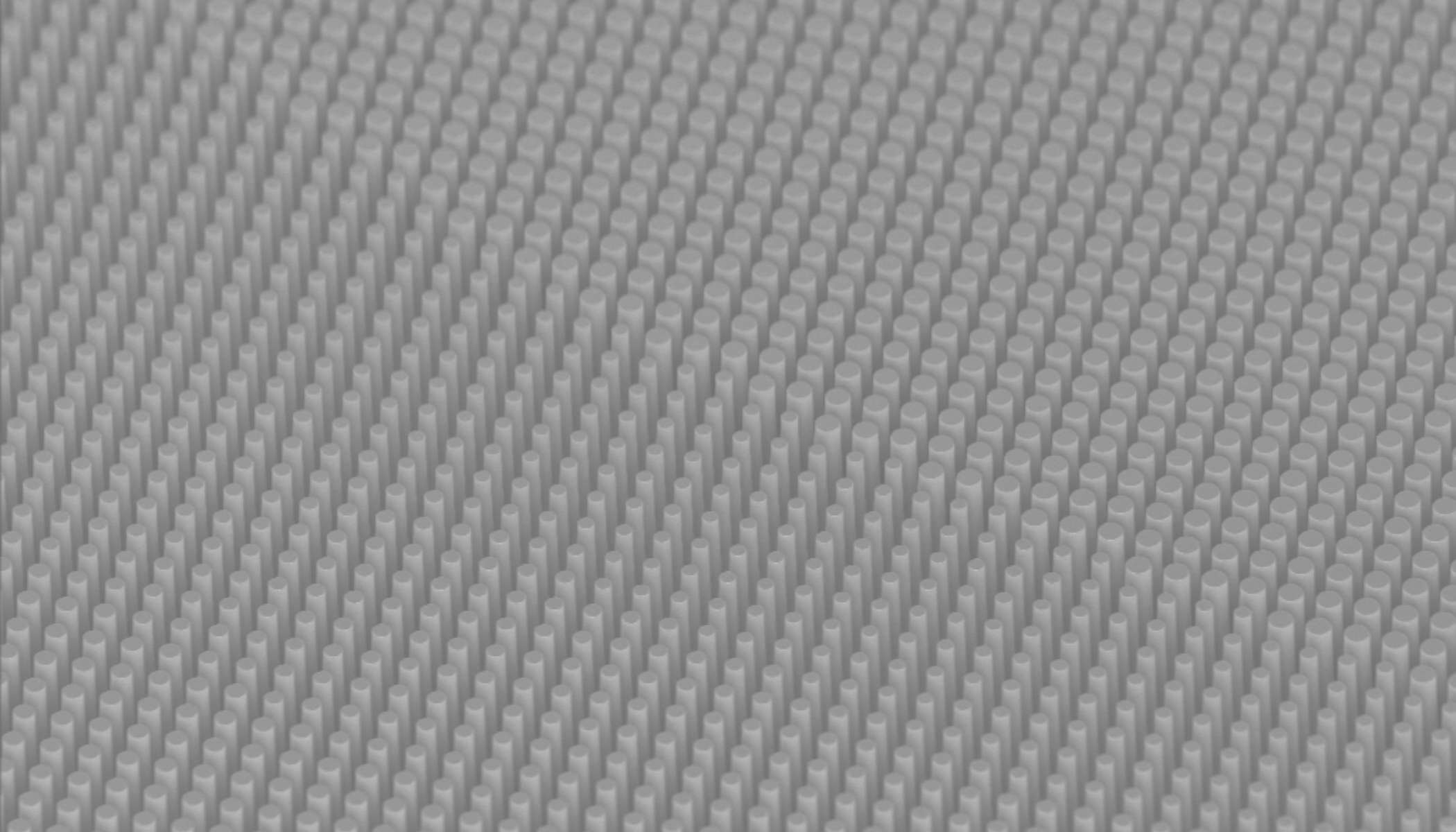
A close-up of a Phaseshift metasurface, the nanostructured optical element at the core of the technology. Credit: Phaseshift
From Cambridge research to real-world systems
A key part of what sets Phaseshift apart is its approach to materials. Many early flat optics platforms rely on silicon, which limits them to certain wavelengths of light. Phaseshift has developed broader capability across materials, enabling it to operate in ultraviolet and visible ranges, which are essential for applications such as quantum systems.
This expands where the technology can be used. With applications across quantum systems, advanced sensing and communications, the platform reflects a wider shift in how optical systems can be built and deployed.
In advanced sensing, this could support areas such as imaging and LiDAR systems used in fields like autonomous technologies and scientific instrumentation.
The future is flat
From shrinking room-sized quantum systems to reducing energy demands in critical infrastructure, the direction of travel is becoming clearer.
As optics move towards flat, semiconductor-based designs, Phaseshift is developing scalable systems that could support this transition, as the age of bulk glass draws to a close and the future of light is completely flat.
Adapted from a Cambridge Enterprise case study. This article first appeared on the University of Cambridge website.
