

Cambridge research into practical approaches for designing better built environments that respond to people’s diverse needs – also known as inclusive neurodesign – has won an international journal’s Best Paper Award for 2026.
Providing designers, industry leaders and policymakers with practical, evidence-based methods grounded in scientific research, can help design neuroinclusive environments where more people can participate, thrive and belong.
Dr Matteo Zallio
The paper titled Exploring Inclusion, Diversity, Equity, and Accessibility in the Built Environment: A Case Study, published in the journal Buildings (MDPI), won the award for demonstrating outstanding scientific merit, originality, research impact and influence.
The paper represents interdisciplinary collaboration on research that examines how architects, engineers and designers can better embrace inclusive design.
The co-authors are Dr Matteo Zallio (Assistant Professor in Architecture and Design at the Department of Architecture, and Co-Lead of the Inclusive Design Group at the Department of Engineering), Professor P. John Clarkson (Professor of Engineering Design and Director of the Cambridge Engineering Design Centre) and Dr Camelia Chivǎran (researcher from the University of Campania "Luigi Vanvitelli", Italy).
An opportunity for growth and positive change
By embedding Inclusion, Diversity, Equity and Accessibility (IDEA) principles throughout the design process using evidence-based design methods, the researchers say it can help create neuroinclusive environments where more people can “participate, thrive and belong”.
The new IDEA Audit Tool was used in a six-month pilot study involving Motionspot, a London-based inclusive design firm that was changing the location of its headquarters from Twickenham to Teddington (both suburban areas of London). The tool assessed how inclusion, diversity, equity and accessibility were perceived by the company’s employees, and how the use of the tool impacted the choice of its new headquarters.
One of the key benefits of using the IDEA Audit Tool is the emphasis it places on proactive measures and continuous improvement. Rather than being solely focused on identifying shortcomings, the tool encourages companies to view the audit process as an opportunity for growth and positive change, as it provides a roadmap for implementing targeted interventions, policies and initiatives that address the identified areas of exclusion.
Improving buildings for everyone
The research demonstrates practical approaches for creating built environments that better respond to people's diverse physical, sensory, cognitive, emotional and social needs in line with neurodesign research and principles.
The work contributes to a growing body of evidence showing that inclusive neurodesign should be understood not as a specialist consideration for a minority of users, but as a fundamental approach to improving the quality, usability and experience of buildings for everyone.
By combining evidence-based design research with insights from human-responsive design, cognitive psychology, and neurodesign, the paper proposes a holistic framework for evaluating and enhancing the inclusiveness of the built environment.
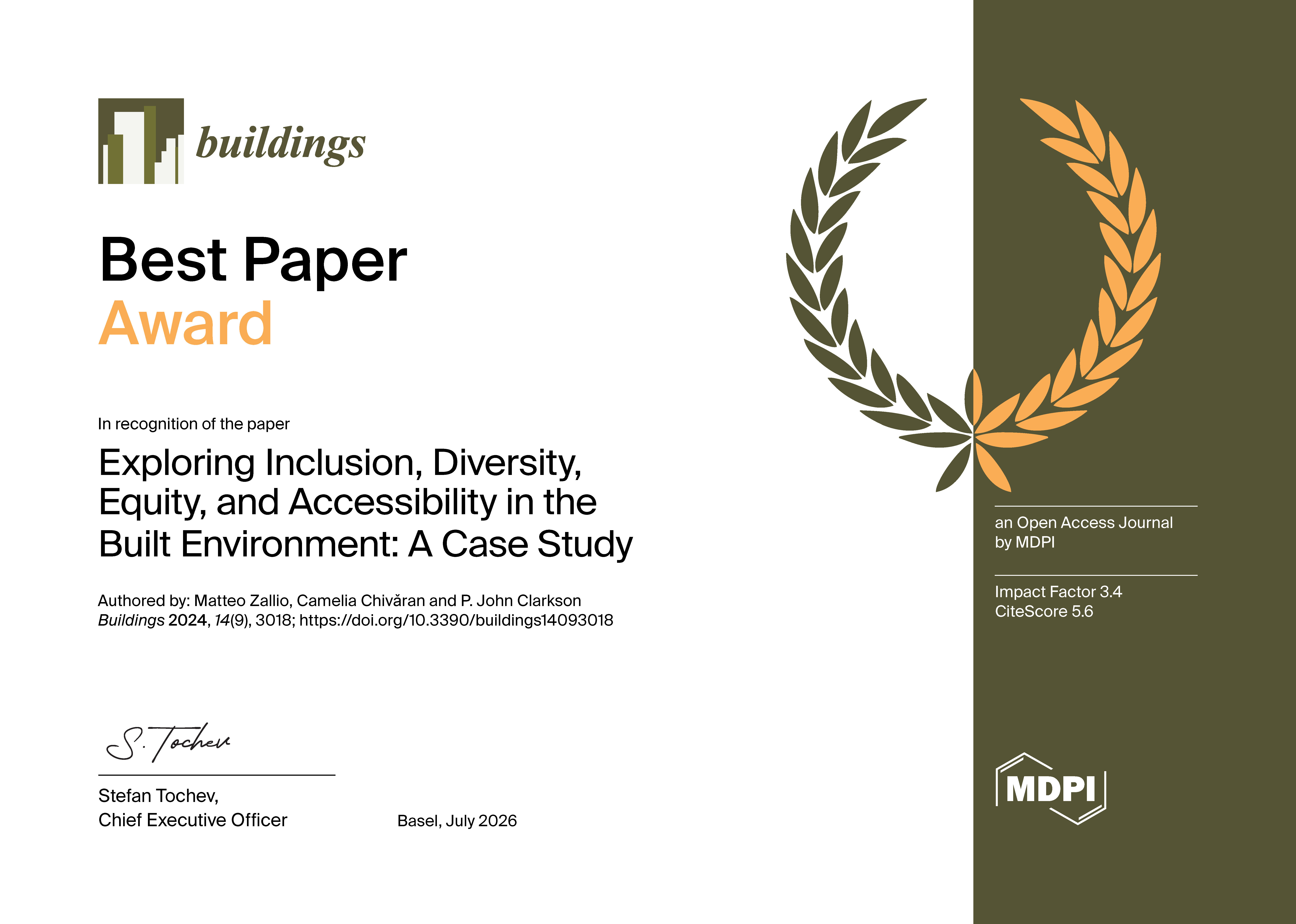
Commenting on the award, Dr Zallio said: “It is a great honour to receive this recognition. Inclusive design has evolved from focusing primarily on accessibility to embracing the full diversity of human capabilities, experiences and aspirations through more data-informed, evidence-based approaches.
“Our ambition is to move above and beyond compliancy and bring the core learnings from academic research into practice. By providing designers, industry leaders and policymakers with practical, evidence-based methods grounded in scientific research, we can help design neuroinclusive environments where more people can participate, thrive and belong.”
Professor Clarkson added: “The provision of well-designed audit tools helps to make the right thing to do the easiest thing to do.”
