
Imagine a future in which a stroke survivor regains movement through an intelligent neural interface. A patient with Parkinson's disease receives highly personalised brain stimulation that adapts in real time to changing symptoms. Someone living with paralysis controls assistive technologies using thought alone.
Engineers can create new devices and algorithms, but successful neurotechnologies also require clinical insight, an understanding of biological systems, regulatory expertise, manufacturing capability and engagement with patients and end users.
Dr Amparo Güemes
Now imagine a student using a wearable neural interface that detects lapses in attention and dynamically adjusts the learning environment in real time to maintain focus and optimise performance.
New forms of closed-loop neurotechnology could enable neurological disease to be identified and treated before symptoms become irreversible, while also opening entirely new ways for humans to interact with intelligent technologies.
These possibilities have captured the imagination of scientists, clinicians and engineers for decades. Yet despite remarkable advances in neuroscience and engineering, relatively few neurotechnologies have translated into routine clinical and real-world use.
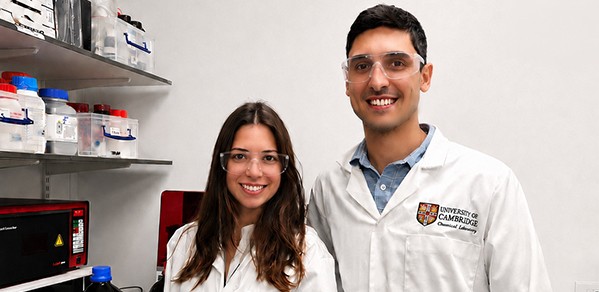
Now, Dr Amparo Güemes, Assistant Professor at the University of Cambridge, Royal Academy of Engineering and Rosetrees Research Fellow, Fellow of Pembroke College, and Head of the Neuro-Metabolic Control Systems Lab, has led a collaborative effort to understand this challenge and define how it can be addressed. She has worked with Dr Ruben Ruiz-Mateos Serrano, former postdoctoral researcher in the Bioelectronics Laboratory and CEO of Polytecks, together with 13 other early-career researchers from across the UK to develop an interdisciplinary roadmap for neurotechnology, which has been published in the journal Science Advances.
Rather than focusing on one device or one area of research, the roadmap asks a much broader question: what is preventing today's exciting laboratory demonstrations from becoming tomorrow's routine clinical and real-world neurotechnologies?
The answer, the researchers argue, lies not only in scientific discovery but in how effectively different communities work together to translate innovation into technologies that can be used safely, reliably and responsibly in the real world.
Engineering meets neuroscience
Neurotechnology sits at one of the most exciting frontiers of modern science. It combines electronics, advanced materials, devices, signal processing, artificial intelligence and neuroscience to create technologies capable of measuring, interpreting and interacting with the nervous system.
The field is advancing rapidly. It is no longer simply a scientific frontier but an emerging technology platform with applications extending from healthcare to education, human performance and new forms of human-computer interaction. Researchers are developing increasingly sophisticated brain-computer interfaces, implantable neural devices, wearable sensors and adaptive stimulation systems that respond intelligently to changing physiological conditions. These are known as closed-loop neurotechnologies.
Unlike traditional 'open-loop' systems, which deliver a fixed treatment regardless of what the body is doing, closed-loop systems continuously monitor biological signals and adapt their behaviour in response. Much like a thermostat automatically regulates temperature or a pacemaker adjusts to changing cardiac rhythms, they use real-time sensing to determine when intervention is needed and how it should be delivered.
This approach has the potential to personalise therapy, improve performance and enable technologies that respond intelligently to both clinical and non-clinical needs.
Yet moving these technologies beyond research laboratories is far from straightforward.
A device that performs exceptionally well in a laboratory experiment may face entirely different challenges when used safely, reliably and affordably in clinical and real-world environments over many years.
"There is a critical disconnect between innovative academic development and the manufacturing infrastructure needed for clinical-grade production," says Dr Güemes. "Bridging this gap requires new funding models for patient capital that can sustain innovation across 20-year clinical translation cycles, moving beyond short-term return horizons that can leave promising technologies abandoned before they reach patients."
From scientific breakthroughs to societal benefit
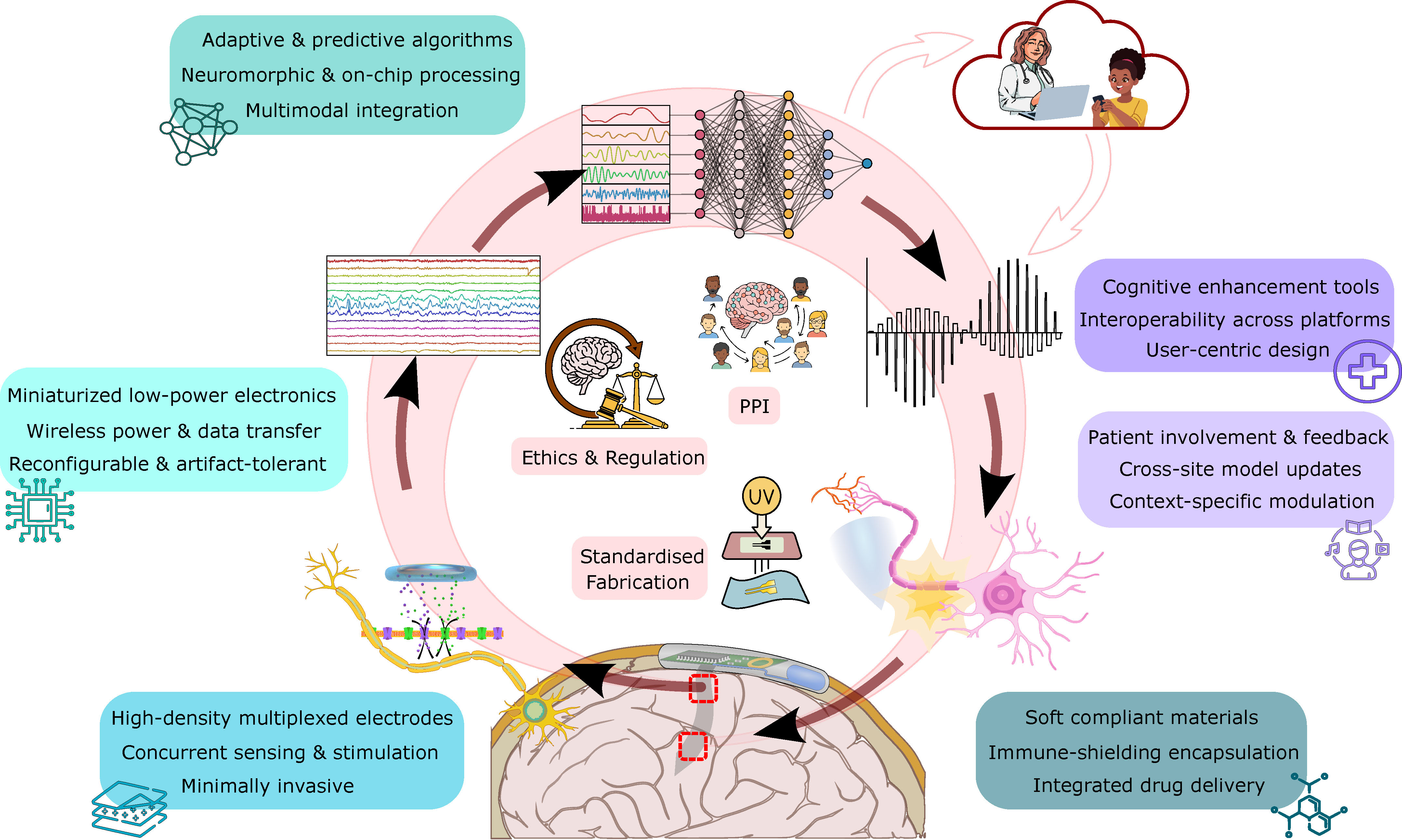
Vision of the future for closed-loop neuromodulation. Credit: Science Advances, Vol. 12, No. 31 [click to enlarge].
A central message of the roadmap is that the future of neurotechnology depends on collaboration by design.
"Neurotechnology is inherently interdisciplinary," says Dr Güemes. "No single field has all the expertise needed to solve the challenges ahead. Engineers can create new devices and algorithms, but successful neurotechnologies also require clinical insight, an understanding of biological systems, regulatory expertise, manufacturing capability and engagement with patients and end users."
The researchers identify a series of interconnected challenges that will determine whether promising neurotechnologies can ultimately deliver meaningful benefits in both clinical and wider real-world settings. Among the most pressing are:
- How can sophisticated devices remain reliable over many years inside the human body or during long-term everyday use?
- How can increasing technical complexity be balanced with affordability, manufacturability and large-scale deployment?
- How can richer streams of neural information be processed rapidly enough to support adaptive decision-making in real time?
- And how can increasingly powerful neurotechnologies be developed responsibly, addressing ethical questions alongside scientific and engineering challenges?
The roadmap highlights the urgent risk of 'abandonware', where implanted devices remain in the human body but lose manufacturer support or serviceability due to company failures or changing commercial priorities.
The challenge is compounded by the growth of ubiquitous 'neurodata', capable of revealing highly sensitive information about human cognition, behaviour and mental states. Ensuring that such information is collected, stored and used responsibly will become increasingly important as neurotechnologies move into everyday life.
Most fundamentally, as adaptive systems begin to influence neural activity in real time, the researchers argue that safeguards must ensure users, clinicians and regulators retain the ability to understand, audit and intervene in system behaviour.
"To ensure responsible development, we must establish globally harmonised regulatory and ethical frameworks that prioritise user safety and technical reliability," says Dr Güemes. "This approach ensures that as neurotechnology moves into everyday healthcare and wider applications, it is governed by rigorous, risk-proportionate oversight that builds lasting trust between researchers, clinicians, end users and society."
By identifying shared challenges rather than focusing on individual technologies, the roadmap provides a framework that researchers from different disciplines can use to coordinate future work.
New collaborative infrastructures, including the University’s Institute of Biomedical Innovation (IBI), are designed to strengthen these connections by bringing together expertise from engineering, medicine and the physical sciences to accelerate the development of neurotechnologies with applications across healthcare and wider society.
“The process of developing this roadmap has demonstrated exactly why collaboration matters,” says Dr Güemes. “By bringing together researchers with different backgrounds, we were able to identify challenges and opportunities that none of us would have seen individually.”
Why this matters
"What excites me most is the shift towards modulating the entire nervous system to treat systemic human physiology – moving beyond just brain research to managing whole-body health," says Dr Güemes.
Advances in neurotechnology could support earlier diagnosis, more personalised therapies, improved rehabilitation and entirely new forms of interaction between people and intelligent technologies. The implications may also extend beyond medicine.
Adaptive neurotechnologies could one day transform education, professional performance, accessibility and entertainment by enabling technologies that respond intelligently to the way people think, learn and interact with the world around them.
"These tools are moving towards a future where they are not only for patients, but for anyone seeking to understand or enhance human capability," says Dr Ruiz-Mateos Serrano.
Looking ahead
The roadmap does not attempt to predict exactly what neurotechnology will look like 20 years from now. Instead, it offers something arguably more valuable: a shared direction of travel.
By identifying common obstacles, encouraging collaboration and aligning scientific innovation with clinical, societal and real-world needs, it provides researchers, funders and policymakers with a framework for translating promising ideas into technologies that can benefit people responsibly.
"This approach ensures that technical performance is balanced with clinical viability, manufacturability and regulatory requirements from the very beginning," says Dr Ruiz-Mateos Serrano, who is now experiencing these challenges first-hand through his company, Polytecks, which focuses on translating medical technologies into real-world applications.
"It helps prevent the development of devices that are technically impressive but ultimately difficult to deploy outside the laboratory," he adds.
For Dr Güemes, publication of the roadmap is also an important milestone. It is her first publication since joining the University of Cambridge as an Assistant Professor in the Department of Engineering, where she is building an ambitious research programme at the intersection of engineering, neuroscience and physiological systems.
"Our initiative calls for a fundamental paradigm shift towards interdisciplinary co-design," says Dr Güemes. "Relevant stakeholders need to work together from the earliest stages of development, rather than being brought in only at the end."
Reference:
Ruiz-Mateos Serrano, R., Troughton, J. G., Mirkhani, N., Martinez, N., Mariello, M., Tsigarides, J., Williamson, S., Sapriza, J., Luca, I. S., Dominguez-Alfaro, A., Cuttaz, E., Thompson, N., Swedick, S., Almulla, L., Güemes, A. ‘From trade-offs to translation: An interdisciplinary roadmap for neurotechnology.' Science Advances (2026). DOI: 10.1126/sciadv.aee8595
Adapted from a news article first published on the Electrical Engineering at Cambridge website – written by Michael Shuff.
