
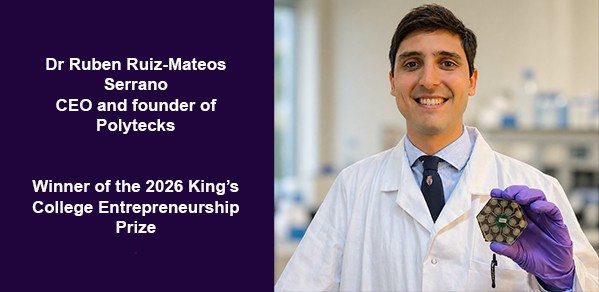
Alumnus Dr Ruben Ruiz-Mateos Serrano has won the 2026 King’s College Entrepreneurship Prize with Polytecks, a start-up with origins in the Department of Engineering.
The prize recognises both the research foundations of Polytecks and the work we are now doing to translate that research into clinical applications. The prize funding will support the filing of critical intellectual property and our veterinary clinical validation programme.
Dr Ruiz-Mateos Serrano
Polytecks is dedicated to faster, earlier and more accurate diagnostics for cardiac abnormalities (including in dogs), with potential applications in neurology, neuroprosthetics, gut health, foetal diagnostics, and beyond.
Now in its 12th year, the competition is intended to encourage King’s members, both past and present, to develop their entrepreneurial ideas and convert their creativity and know-how for sustainable commercial and social benefit.
This year’s top prize, with a value of £20,000, has been awarded to Polytecks – a medical technology start-up that is developing flexible bioelectrical mapping technology that turns the body’s natural signals into a new, non-invasive view of disease.
Polytecks’ first-of-its-kind flexible sensors use wearable electronic textile-based (e-textile) high-density electrode arrays to capture high-resolution bioelectrical signals from the body’s surface – making the skin a window into the body.
Built on new conducting materials, engineering techniques and machine learning, Polytecks' next-generation arrays make advanced diagnostics as easy to use as a stethoscope, with the clear aim of establishing bioelectrical mapping as a mainstream diagnostic category.
Every cell in the body runs on electricity. Reading these signals has the potential to make advanced healthcare accessible, including new diagnostics for the brain, heart and muscle.
The company is entering the market through veterinary cardiology to accurately stage cardiovascular disease at the point of care, while scaling its platform to map the nervous system, muscles, gut and ultimately anything electrically active in the body.
Dr Ruiz-Mateos Serrano said: “Winning the King’s College Entrepreneurship Prize was a real honour, particularly because the prize recognises both the research foundations of Polytecks and the work we are now doing to translate that research into clinical applications. The prize funding will support the filing of critical intellectual property and our veterinary clinical validation programme.
“Our immediate focus is on completing the clinical validation of SwiftStage (Polytecks’ first product) for staging canine myxomatous mitral valve disease, the most common heart condition in dogs. Early detection is crucial, as timely medication can extend life. We are also continuing to develop the technology and prepare for future human applications. We are at a very exciting stage, and I’m looking forward to seeing where the next few years take us.”
Towards practical brain-body interfaces: The Last Frontier
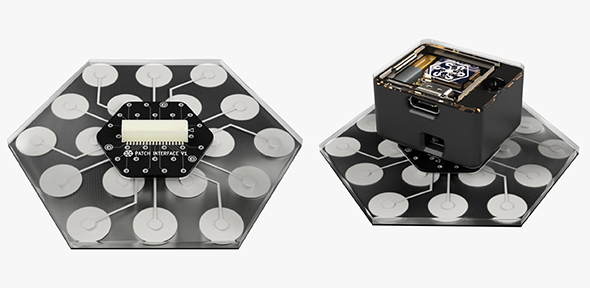
A closer look at the wearable Polytecks Mosaic Platform. Credit: Polytecks
Polytecks grew out of the Cambridge ecosystem and maintains strong research links with the University.
Dr Ruiz-Mateos Serrano recently had his new research on applications of Polytecks’ bioelectrical mapping technology for wearable brain-body interfaces published in Nature Communications.
The paper titled Body surface potential mapping of the cortico-muscular axis using smart textile electrode arrays represents the culmination of his PhD conducted at the Centre for Doctoral Training in Connected Electronic and Photonic Systems (CEPS), as well as several years of work developing the technology that laid the scientific and technical foundations for what would become Polytecks.
The paper’s findings revealed that Polytecks’ hybrid e-textile electrode array system successfully improved electrode performance, connectivity and wearability, and produced interpretable machine learning algorithms for data analysis.
In controlled single-subject experiments, the technology demonstrated reliable muscle and brain recordings, enabling classification of grasped object shapes and different sensory stimuli, including auditory and visual cues.
The study’s findings represent a step towards practical brain-body interfaces with applications in neurorehabilitation, prosthetics and human-machine interaction.
“The publication in Nature Communications is especially meaningful to me,” said Dr Ruiz-Mateos Serrano. “It is exciting to see that research now developing into a company with the potential to improve diagnosis and monitoring in both veterinary and human medicine.”
Adapted from a King’s College news article.
