
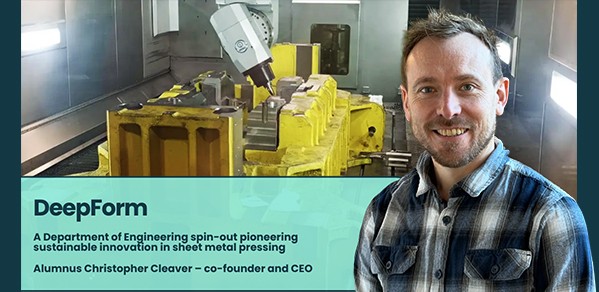
Department spin-out DeepForm – a company pioneering sustainable innovation in sheet metal pressing – has announced its involvement in a major commercial demonstration project backed by the UK Government.
When we spun out of the University of Cambridge in 2022, fold-flow pressing was a laboratory result. It is now a production technology, and the pull we are seeing from major manufacturers reflects that.
Alumnus Dr Christopher Cleaver
The one-year project titled ‘DeepForm for Trucks’ is a joint industrial venture with Volvo Trucks Technology & Industrial and Whiston Industries. It will see DeepForm develop and test a demonstration pressing tool using its patented fold-flow technology on a critical steel structural component used inside Volvo truck cabs – significantly reducing material waste, production costs and carbon emissions.
The project is backed by the Advanced Propulsion Centre UK (APC) and Innovate UK under the UK Government's DRIVE35 (Driving Research & Investment in Vehicle Electrification) programme – a £4 billion programme of capital and research and development funding for the automotive industry to 2035.
DeepForm, which was founded in 2022 by CEO Dr Christopher Cleaver (a former senior research associate in the Department of Engineering) and non-executive director Professor Julian Allwood (Head of the Use Less Group at Cambridge) is built on almost a decade of research carried out in the Department of Engineering. This is where the company’s founders developed the patented fold-flow pressing process to minimise waste and transform how metal parts are made.
Dr Cleaver explains the process: “When you make a sheet metal part, you have to grip the metal to stop it wrinkling as a flat sheet is formed into shape. Normally this is done by adding extra material around the edge of the sheet and clamping it. That extra material is then trimmed off and sent for remelting or scrap.
“Instead, we fold the metal onto small, local 3D grips, and the metal flows off these grips to form the part. This means we need far less extra metal, and we form it more gently.”
Supporting the transition to net-zero manufacturing
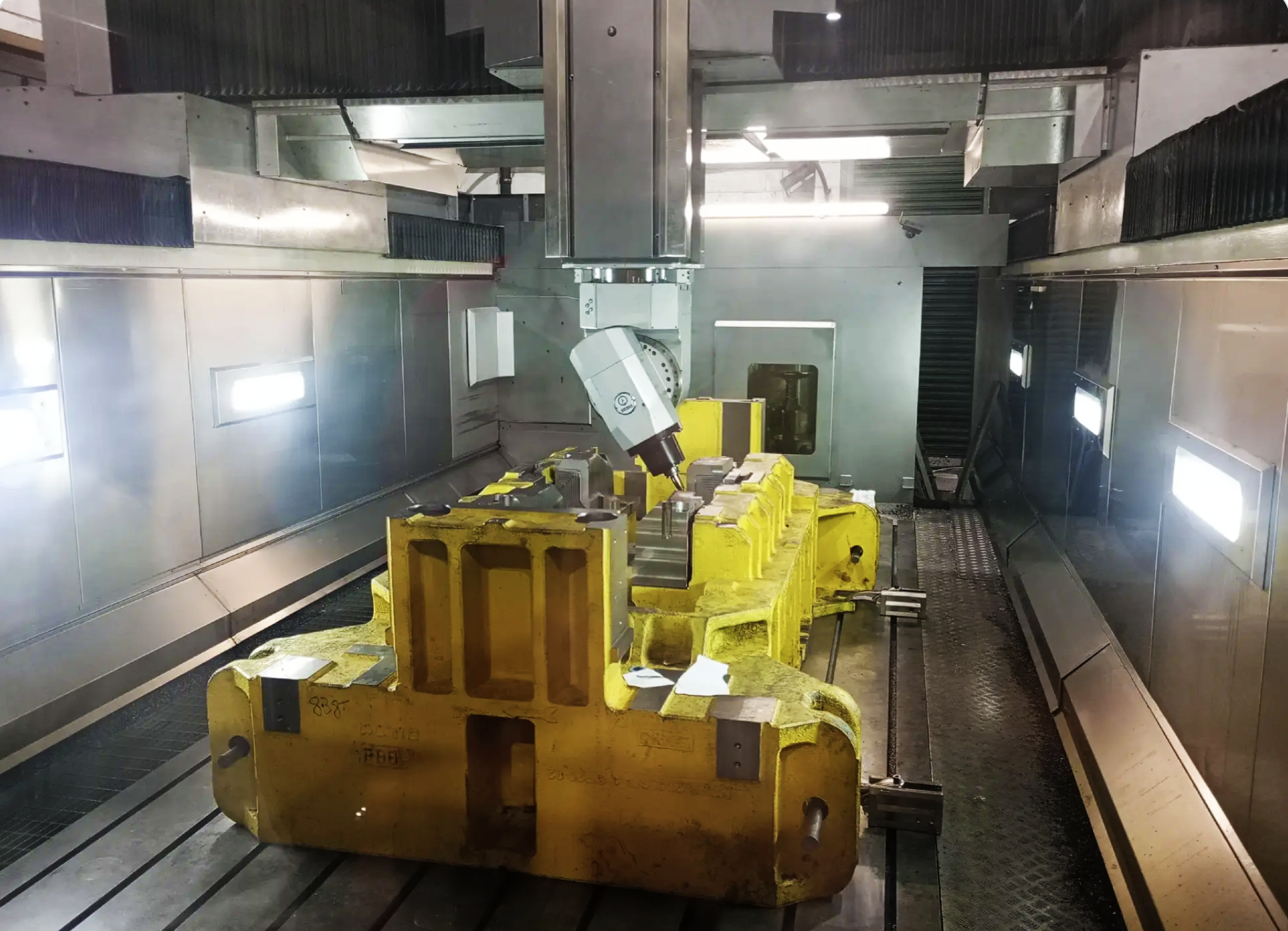
Machining the upper half of one of DeepForm's first auto press tools. Credit: DeepForm
DeepForm’s breakthrough technology uses a data-led understanding of material behaviour, advanced simulation, and tool design principles developed through rigorous research. The result is a smarter, more efficient alternative to conventional metal forming that reduces waste, cuts CO₂ emissions, and integrates seamlessly into existing production systems – supporting the transition to net-zero manufacturing.
Dr Cleaver says: “On one recent Jaguar Land Rover project, we cut trimming waste from 47% to 12%, which reduced the part's CO2 emissions by 32%.
“By cutting manufacturing scrap at source, DeepForm reduces overall demand for metal production and enables original equipment manufacturers (OEMs) to make the largest possible reduction in the embodied emissions of their metal products.”
He adds: “When we spun out of the University of Cambridge in 2022, fold-flow pressing was a laboratory result. It is now a production technology, and the pull we are seeing from major manufacturers reflects that.
“We've built a great team of 18 and taken our ideas to market, first with big, well-known automotive customers and more recently with white goods manufacturers (like dishwashers and cookers) and beverage cans. Beverage can and white goods manufacturers face the same waste in their metal pressing as auto OEMs. We can help manufacturers cut waste, cost and CO2 emissions, make parts with tighter radii, or use materials with higher recycled content.
“Our greatest achievement so far is a project where we helped a first-tier auto stamper solve a production issue on an aluminium part, which should enter mass production later this year.”
In summing up his experience since founding DeepForm, Dr Cleaver, who has a Master of Engineering (MEng) degree and a PhD from Cambridge, advises researchers exploring a similar route to join an accelerator programme to help strengthen the commercial impact of their technology.
“I've enjoyed the freedom of taking an idea out into the world, and building a team around a huge opportunity,” he says. “My advice is to do an accelerator programme, and there are plenty out there. I did the Maxwell Centre's Impulse Programme and then a Royal Academy of Engineering Enterprise Fellowship. Both were a great source of advice and inspiration and gave me space to rethink our technology as a business offering.”
